




.jpg)
Your buyer is on your pricing page at 11:14 p.m. They have three competitors open and no desire to “hop on a quick call.”
Gartner surveyed 646 B2B buyers and found 67% prefer a rep-free experience. Another 45% used AI during a recent purchase. If your website hides the useful stuff behind a form, those buyers do not become leads. They become somebody else's pipeline.
Here is the gap: rep-free does not mean rep-less. Your website needs two lanes. One supports independent evaluation. The other introduces a human when context, risk, or approval makes that help valuable. A “Book a Demo” button is not a buyer journey. It is an exit sign.
Key takeaways
- Let buyers understand fit, value, cost, risk, and next steps without a meeting.
- Give each buying-committee member proof they can share internally.
- Keep website and sales information synchronized.
- Offer human help as validation, not an information tollbooth.
What does rep-free selling mean for a B2B website?
Rep-free selling means your website helps a buyer research, compare, build a business case, reduce risk, and choose a next step without mandatory sales contact.
It does not remove sales. It moves reps from basic information delivery to high-value validation, advice, and decision support.
The distinction matters. Gartner later found 69% prefer reps to validate AI-generated insights, while 70% prefer digital self-service. Buyers want control first and expertise when the stakes rise.
A strong web design and development strategy lets buyers move between self-service and human support without losing context.
Use two clear paths:
- “Explore on your own” for pricing, demos, proof, security, FAQs, and comparisons.
- “Talk through my situation” for complex fit, implementation, procurement, and approval questions.
Our B2B buyer behavior guide covers the wider journey.
What information should buyers find without talking to sales?
Buyers should find enough information to judge fit, expected outcomes, commercial range, implementation effort, proof, risk, and purchase steps.
You do not need to publish every contract term.
You do need to remove the uncertainty that forces a call before the buyer knows whether a call is worthwhile.
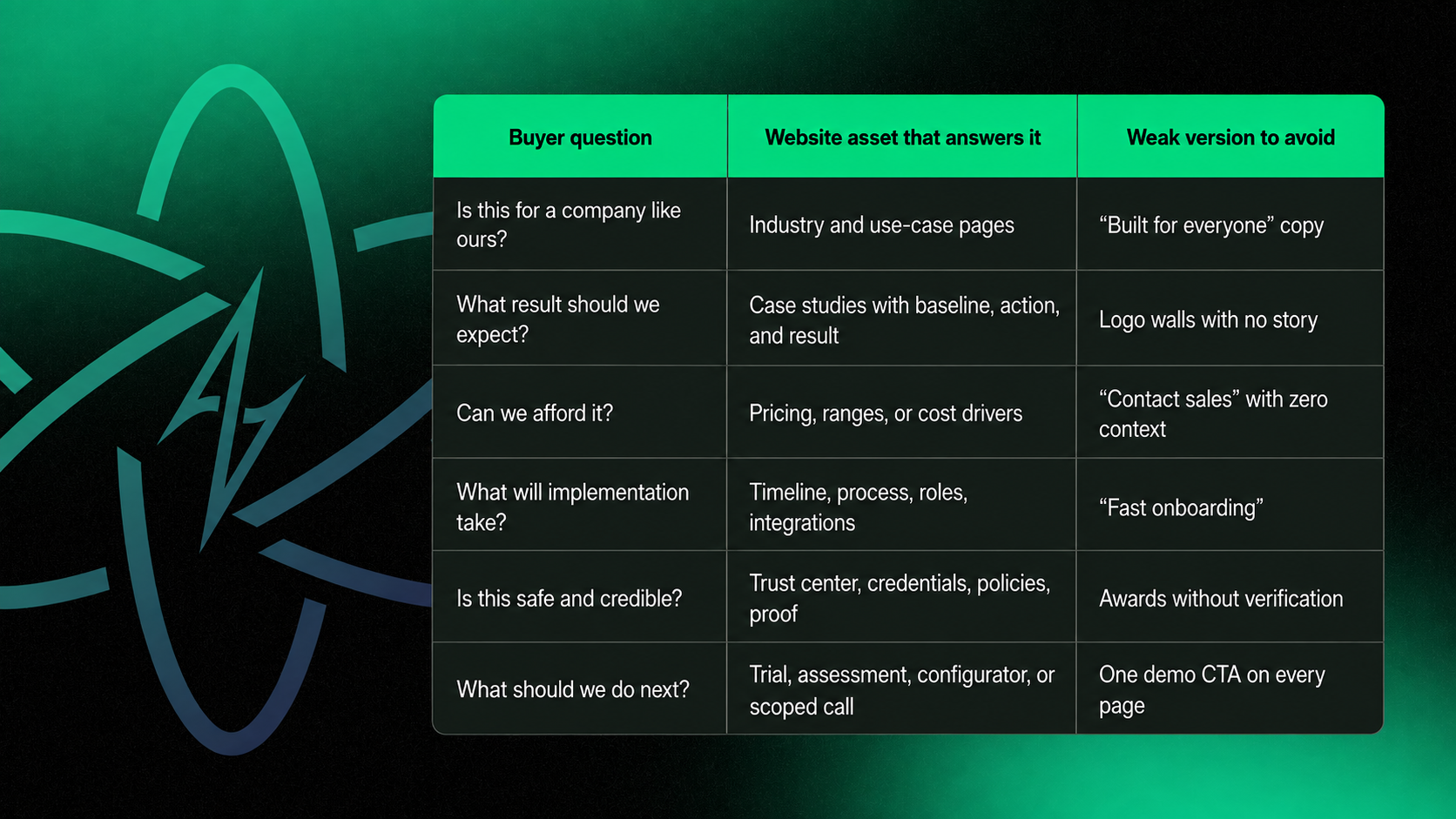
Your case studies should help a champion defend the choice. Your content marketing should answer objections. Your SEO program should make those answers findable.
If exact pricing varies, publish starting prices, ranges, cost drivers, and what changes the quote. “It depends” is not complete.
[EXPERT QUOTE NEEDED: Why useful pricing context qualifies buyers better than a blank contact-sales gate.]
.png)
How should your website help a buying committee reach consensus?
Your website should give each stakeholder role-specific answers and a shareable business case. Executives need outcomes. Finance needs cost logic.
IT needs integrations and security. End users need workflow clarity. Procurement needs terms and risk details. One generic product page cannot carry all five conversations.
Self-service must help the researcher sell the decision internally.
Build a committee kit with:
- A one-page executive summary
- An ROI or cost-of-inaction calculator
- A security and compliance page
- An implementation timeline
- Role-specific use cases
- Downloadable proof with source links
- A vendor comparison worksheet
Gartner found 74% of buyer teams show unhealthy conflict, while consensus groups are 2.5 times more likely to report a high-quality deal. Your site should settle arguments early.
Proof differs by market. A healthcare buyer needs privacy and credentials. An aesthetic practice needs booking-flow proof. A solar company needs territory and financing clarity.
.png)
Which self-service tools actually move B2B buyers forward?
The best self-service tools complete a buying task instead of adding novelty.
Use interactive demos for product understanding, calculators for value, configurators for scope, assessments for diagnosis, comparison tools for evaluation, and searchable knowledge bases for due diligence.
Each tool should produce a useful answer or artifact.
Choose the tool by the friction:
- “I cannot picture it.” Add an interactive demo or annotated walkthrough.
- “I cannot justify it.” Add an ROI calculator with visible assumptions.
- “I do not know what I need.” Add a short assessment or configurator.
- “I cannot verify the claim.” Add methodology, source data, and a relevant case study.
- “I cannot get approval.” Generate a summary the champion can share.
Do not put an AI chatbot on thin content and call it enablement. It needs accurate pricing, service boundaries, and escalation rules. Otherwise, it is a confident intern who never sleeps.
A digital marketing strategy connects tools, search pages, and follow-up. Smart email marketing continues the journey without carpet-bombing the inbox.
.png)
When should a rep enter a rep-free buying journey?
A rep should enter when the buyer asks for help or when the decision requires context that static content cannot safely provide.
Good triggers include complex fit, security review, implementation planning, customized economics, procurement, and conflicting stakeholder needs.
The handoff should preserve what the buyer already shared.
Do not make a buyer complete an assessment and then explain everything again on a call.
The handoff should pass:
- Pages and tools used
- Selected use case and company profile
- Stated priorities or risks
- Calculator assumptions
- Questions the website could not answer
Gartner found 69% reported inconsistencies between website and seller information. Information parity is trust infrastructure.
For complex services, a roofing company may need inspection details. A home improvement business may need measurements. Collect useful context before the call.
[EXPERT QUOTE NEEDED: How to design a self-service-to-sales handoff without making the buyer repeat the journey.]
How do you know whether your website supports rep-free selling?
Audit whether a qualified buyer can answer six questions without contacting you:
- Is this for me?
- What outcome can I expect?
- What will it cost?
- How does it work?
- What could go wrong?
- What can I do next?
Any missing answer is a conversion leak, not a content preference.
Give an outsider a real buying scenario and no tour. Watch where they stall or ask for a person.
Then track:
- Pricing-page exits and next clicks
- Demo, calculator, or assessment completion
- Case-study paths before conversion
- Self-service versus assisted conversion
- Sales questions that repeat website topics
- Qualified pipeline influenced by key assets
Use GEO alongside SEO so AI engines can retrieve those answers. 6sense research found the winning vendor was on the Day One shortlist 95% of the time. Build proof early, whether you sell to solar businesses or national teams.
Patch pages one by one, or let Aesthetics Digital map buyer tasks and rebuild the path. See how our growth strategy works.
.png)
Frequently Asked Questions
Stop making information expensive
Your buyer may avoid your rep. They are not avoiding a decision.
Give them the pricing context, proof, tools, and risk answers to move forward. Then make human help easy when judgment matters. That is rep-free selling done right.
Ready to see where your website forces unnecessary sales contact?
Request a rep-free buyer journey audit from Aesthetics Digital.

At Aesthetics Digital, big ideas deserve bold execution.
Table of Content



%20(1).png)



.svg)

.svg)
.svg)


.svg)