

Universal TOC for Webflow – CMS & Static Content Ready

View CMS page demo
Published on
22 Jan 2024
Desk with computer
TABLE OF CONTENT
Subscribe to our newsletter
Read about our privacy policy.
Thank you! Your submission has been received!
Oops! Something went wrong while submitting the form.

For the ToC we use H1-H4

Mi tincidunt elit, id quisque ligula ac diam, amet. Vel etiam suspendisse morbi eleifend faucibus eget vestibulum felis. Dictum quis montes, sit sit. Tellus aliquam enim urna, etiam. Mauris posuere vulputate arcu amet, vitae nisi, tellus tincidunt. At feugiat sapien varius id.

Eget quis mi enim, leo lacinia pharetra, semper. Eget in volutpat mollis at volutpat lectus velit, sed auctor. Porttitor fames arcu quis fusce augue enim. Quis at habitant diam at. Suscipit tristique risus, at donec. In turpis vel et quam imperdiet. Ipsum molestie aliquet sodales id est ac volutpat.

Meeting
Image caption goes here

Elit nisi in eleifend sed nisi. Pulvinar at orci, proin imperdiet commodo consectetur convallis risus. Sed condimentum enim dignissim adipiscing faucibus consequat, urna. Viverra purus et erat auctor aliquam. Risus, volutpat vulputate posuere purus sit congue convallis aliquet. Arcu id augue ut feugiat donec porttitor neque. Mauris, neque ultricies eu vestibulum, bibendum quam lorem id. Dolor lacus, eget nunc lectus in tellus, pharetra, porttitor.

"Ipsum sit mattis nulla quam nulla. Gravida id gravida ac enim mauris id. Non pellentesque congue eget consectetur turpis. Sapien, dictum molestie sem tempor. Diam elit, orci, tincidunt aenean tempus."

Tristique odio senectus nam posuere ornare leo metus, ultricies. Blandit duis ultricies vulputate morbi feugiat cras placerat elit. Aliquam tellus lorem sed ac. Montes, sed mattis pellentesque suscipit accumsan. Cursus viverra aenean magna risus elementum faucibus molestie pellentesque. Arcu ultricies sed mauris vestibulum.

How to know what design works better

Senectus nam posuere ornare leo metus, ultricies. Blandit duis ultricies vulputate morbi feugiat cras placerat elit. Aliquam tellus lorem sed ac. Montes, sed mattis pellentesque suscipit accumsan. Cursus viverra aenean magna risus elementum faucibus molestie pellentesque. Arcu ultricies sed mauris vestibulum.

Montes, sed mattis pellentesque suscipit accumsan. Cursus viverra aenean magna risus elementum faucibus molestie pellentesque. Arcu ultricies sed mauris vestibulum. Montes, sed mattis pellentesque suscipit accumsan. Cursus viverra aenean magna risus elementum faucibus molestie pellentesque. Arcu ultricies sed mauris vestibulum.

Nunc sed faucibus bibendum feugiat sed interdum. Ipsum egestas condimentum mi massa. In tincidunt pharetra consectetur sed duis facilisis metus. Etiam egestas in nec sed et. Quis lobortis at sit dictum eget nibh tortor commodo cursus.

How to manage A/B testing on Webflow

Morbi sed imperdiet in ipsum, adipiscing elit dui lectus. Tellus id scelerisque est ultricies ultricies. Duis est sit sed leo nisl, blandit elit sagittis. Quisque tristique consequat quam sed. Nisl at scelerisque amet nulla purus habitasse.

Nunc sed faucibus bibendum feugiat sed interdum. Ipsum egestas condimentum mi massa. In tincidunt pharetra consectetur sed duis facilisis metus. Etiam egestas in nec sed et. Quis lobortis at sit dictum eget nibh tortor commodo cursus.

Iterate and optimize

Morbi sed imperdiet in ipsum, adipiscing elit dui lectus. Tellus id scelerisque est ultricies ultricies. Duis est sit sed leo nisl, blandit elit sagittis. Quisque tristique consequat quam sed. Nisl at scelerisque amet nulla purus habitasse.

Nunc sed faucibus bibendum feugiat sed interdum. Ipsum egestas condimentum mi massa. In tincidunt pharetra consectetur sed duis facilisis metus. Etiam egestas in nec sed et. Quis lobortis at sit dictum eget nibh tortor commodo cursus.

Conclusion

Morbi sed imperdiet in ipsum, adipiscing elit dui lectus. Tellus id scelerisque est ultricies ultricies. Duis est sit sed leo nisl, blandit elit sagittis. Quisque tristique consequat quam sed. Nisl at scelerisque amet nulla purus habitasse.

Nunc sed faucibus bibendum feugiat sed interdum. Ipsum egestas condimentum mi massa. In tincidunt pharetra consectetur sed duis facilisis metus. Etiam egestas in nec sed et. Quis lobortis at sit dictum eget nibh tortor commodo cursus.

Odio felis sagittis, morbi feugiat tortor vitae feugiat fusce aliquet. Nam elementum urna nisi aliquet erat dolor enim. Ornare id morbi eget ipsum. Aliquam senectus neque ut id eget consectetur dictum. Donec posuere pharetra odio consequat scelerisque et, nunc tortor.


H4 Nulla adipiscing erat a erat.

Etiam egestas in nec sed et. Quis lobortis at sit dictum eget nibh tortor commodo cursus.

H5 Demo, not in use for creating ToC.

sed interdum. Ipsum egestas condimentum mi massa. In tincidunt pharetra consectetur sed duis facilisis metus. Etiam egestas in nec sed et. Quis lobortis at sit dictum eget nibh tortor commodo cursus.

Latest posts

Demo content

Interviews, tips, guides, industry best practices, and news.
Office setting
Design
8 min read

UX review presentations

How do you create compelling presentations that wow your colleagues and impress your managers?
Read post
Man working at desk
Product
8 min read

Migrating to Linear 101

Linear helps streamline software projects, sprints, tasks, and bug tracking. Here’s how to get started.
Read post
Man pinning images on wall

Building your API Stack

The rise of RESTful APIs has been met by a rise in tools for creating, testing, and managing them.
Read post

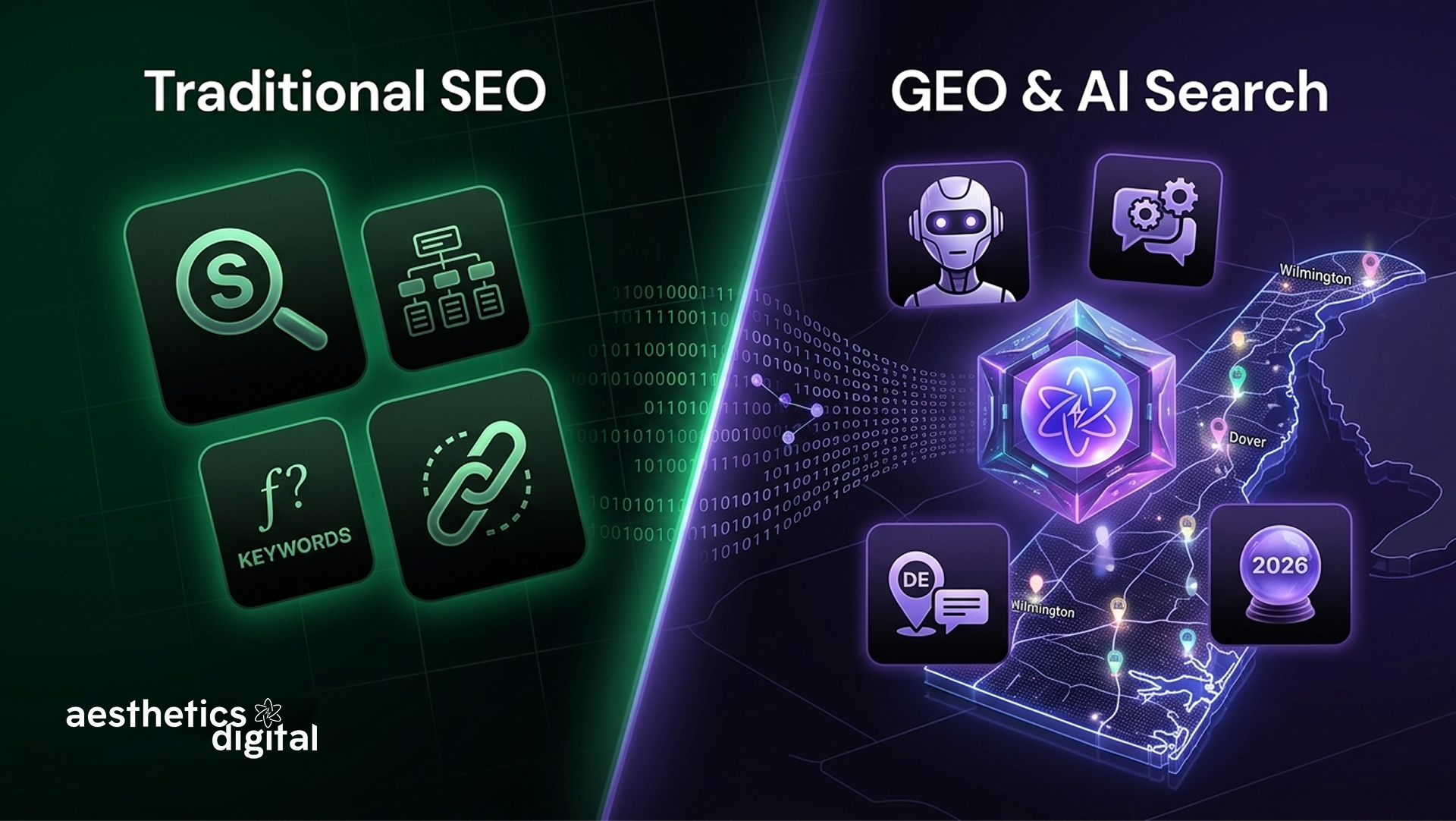
GEO vs SEO: The 2026 Guide Every Delaware Business Owner Needs to Survive AI Search

GEO vs SEO: The 2026 Guide Every Delaware Business Owner Needs to Survive AI Search

Category:

Author:

Aesthetics Digital

GEO vs SEO guide for Delaware businesses adapting to Google AI Search in 2026.

GEO vs SEO: The 2026 Guide Every Delaware Business Owner Needs to Survive AI Search

Category:

Author:

Aesthetics Digital

GEO vs SEO guide for Delaware businesses adapting to Google AI Search in 2026.

If you’ve been on LinkedIn in the last six months, you’ve seen the posts. “SEO is dead.” “GEO is the future.” “Everything you know about ranking is obsolete.

A lot of noise. A lot of panic. Very little useful information for a business owner in Delaware trying to figure out what to actually do.

Here’s the truth, and it’s more useful than the hot takes: GEO and SEO are not fighting each other. They’re the same engine running on a bigger track.

Once you understand how they work together, you stop guessing and start executing. 

First, What Are GEO and SEO? (Plain English, No Jargon)

SEO: Search Engine Optimization

Getting your website to appear when someone searches Google. It’s built on content quality, technical site health, local signals, backlinks, and relevance. You’ve heard of this. You probably know you need it.

GEO: Generative Engine Optimization

Getting your content cited inside AI-generated answers. Google AI Overviews, AI Mode, ChatGPT, and Perplexity. Same goal as SEO (get found), different surface (an AI answer instead of a blue link list).

And here’s where it gets important. On May 15, 2026, Google published their first official guide on optimizing for AI search. Their exact words:

From Google Search’s perspective, optimizing for generative AI search is optimizing for the search experience, and thus still SEO.

That’s not a blogger’s take. That’s Google’s published documentation.

GEO and SEO are not two separate strategies. They are the same strategy applied to an AI-powered surface.

If you’re doing strong SEO, you are already doing GEO for Google. The question is whether you’re doing both well enough.

So, Why Is Everyone So Confused?

Because the confusion is real, even if the panic is overblown. Here’s what’s actually different in 2026, and why it matters even though the strategy is unified.

The Overlap Gap Is Only 38%

Research shows that only 38% of the content showing up in AI-generated answers is the same content ranking in traditional organic results.

That 62% gap is what’s creating all the anxiety. Ranking on page one doesn’t automatically get you cited in AI answers yet.

The gap is real. The strategy to close it is not mysterious. Like:

  • better content structure
  • sharper E-E-A-T signals
  • fresher pages.

AI Mode and AI Overviews Are Not the Same Thing

This is the distinction most articles skip over, and it matters for your business.

  • AI Overviews appear above the traditional search results. Traditional blue links still show up below them. Ranking well still gets you some visibility even if you’re not in the AI answer.
  • AI Mode replaces the entire results page with a conversational interface. There are no blue links below it. You are either cited as a source or you receive zero visibility for that search. No middle ground.

AI Mode just surpassed one billion users. That number is growing every quarter. The percentage of searches where you’re either cited or invisible is increasing. That’s the real urgency here, not the death of SEO.

Non-Google AI Platforms Play by Different Rules

Google’s optimization guide only covers Google. ChatGPT, Perplexity, and other AI platforms pull from different sources and rank signals.

A complete visibility strategy in 2026 runs two tracks:

  1. Strong foundational SEO for Google (which gives you AI Overviews and AI Mode)
  2. Proactive authority-building for external LLMs (which gets you cited in ChatGPT and Perplexity)

For most small businesses in Delaware, Google is where 90% of the opportunity sits. Start there.

How AI Search Actually Works? The Two Mechanics You Need to Know

RAG: Why Your Website Content Still Matters More Than Ever?

RAG stands for Retrieval-Augmented Generation. It’s how Google keeps AI answers accurate instead of made-up

Rather than generating an answer from a model’s memory alone, Google uses its core Search ranking systems to retrieve relevant, up-to-date pages from the Search index.

It reads the actual content from those pages and builds a response with clickable links back to the sources.

The practical implication: if your page is indexed and ranking in traditional search, it is already in the pool for AI citation.

There is no separate AI index. There is no secret backdoor. Win SEO, and you become eligible for AI answers. The two surfaces are rooted in the same foundation.

Query Fan-Out: Why One Deep Blog Post Can Rank for 10 Different Searches

When a user submits a query, Google’s AI doesn’t just search for that exact phrase. It generates a set of related sub-queries to build a more complete answer.

Google’s own published example: a search for “how to fix a lawn full of weeds” fans out into “best herbicides for lawns,” “remove weeds without chemicals,” and “how to prevent weeds in lawn” all simultaneously.

Your content can be surfaced for queries you never explicitly targeted, as long as your page covers the topic with enough depth and clarity.

For a Delaware med spa, one well-built blog post about Botox consultations can get cited for “Botox near Wilmington,” “what to expect at a med spa,” “how long does Botox last,” and “best marketing agencies in Delaware” from a single page.

One deep guide is worth more than ten thin posts chasing keyword variations.
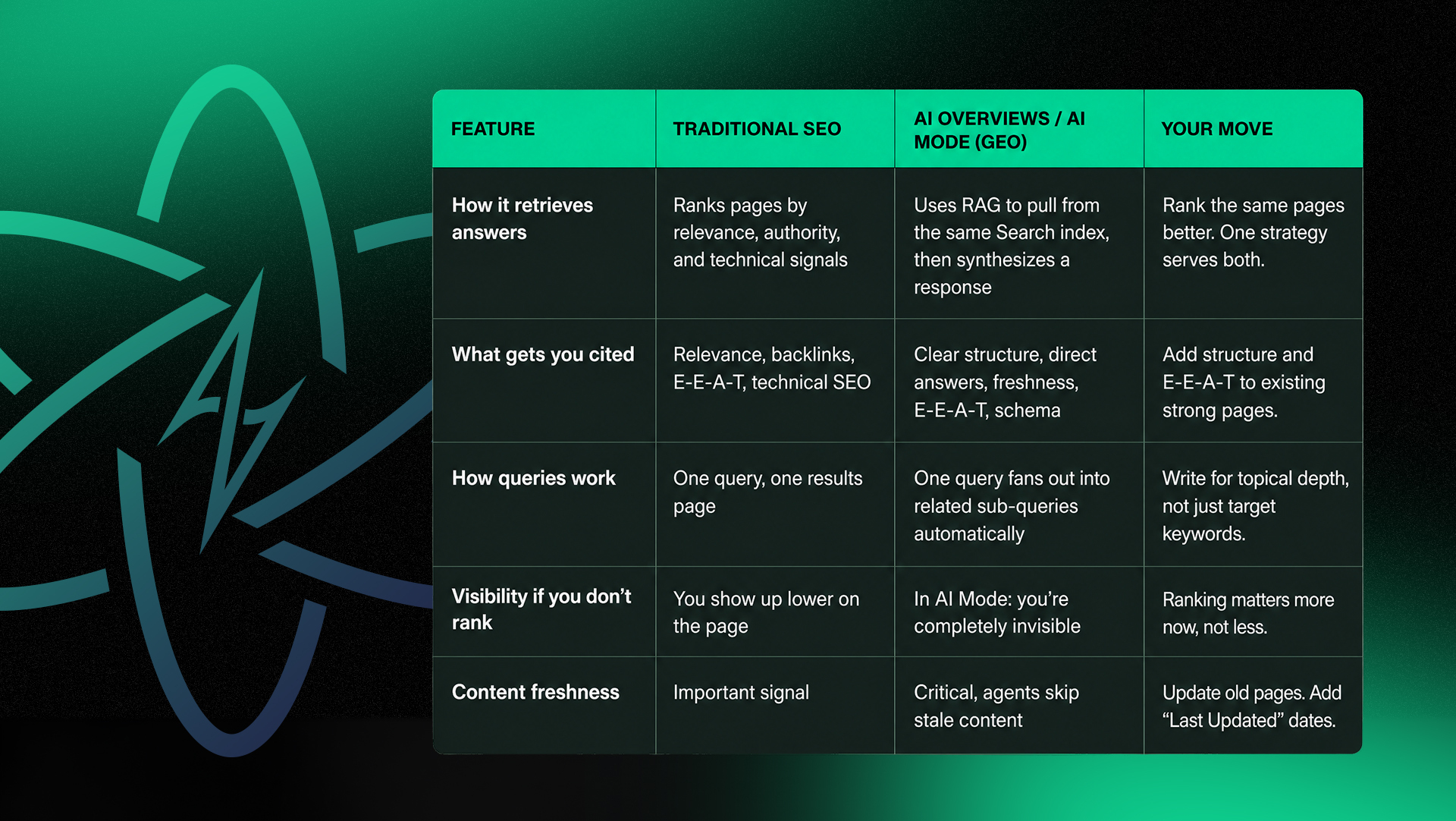
Comparison table showing how Google AI Search uses query fan-out and Retrieval-Augmented Generation (RAG) differently from traditional SEO.

What You Need to Stop Doing Immediately

Google’s official guide killed several popular “GEO tactics” outright. Stop spending time on these:

  • Creating llms.txt files. Google’s guide is explicit: these are not required and are not treated as special signals. Not a ranking factor. Not a citation factor. Skip it.
  • Chunking your content into tiny AI-digestible pieces. Google’s systems understand multiple topics on a single page and surface the relevant section per query. Don’t fragment your content.
  • Chasing inauthentic mentions. Manufactured citations from unrelated sites or paid placements are penalized, not rewarded.
  • Treating every new AI trend announcement as a reason to tear down what’s working. Your SEO foundation is still your most valuable asset. Upgrade it. Don’t abandon it.

The 2026 Playbook: What Delaware Business Owners Need to Do Right Now

  1. Write for topical depth, not keyword density. Query fan-out means Google’s AI will surface your content for related searches you didn’t explicitly target, if your content builds genuine authority on the topic. One comprehensive guide beats ten thin posts every time.
  2. Open every page with a direct answer sentence. AI retrieval pulls the clearest, most quotable sentence first. If your page opens with a warm-up paragraph, a rhetorical question, or company history, the AI moves to the next result. Answer the question in the first sentence.
  3. Add FAQ sections to every key page. Each FAQ entry is a separate sub-query match. This is the single highest-leverage structural change most Delaware businesses can make this month. Build them into service pages, location pages, and blog posts.
  4. Publish original data, expert quotes, and cited statistics. AI systems favor non-commodity content. Your own case study results, a quote from Feroz with a specific insight, a Delaware-specific statistic, these are things no competitor can copy. That originality is what earns citations over generic content.
  5. Keep your content fresh and attributed. Named authors. Publication dates. Updated statistics. “Last Updated” labels. These aren’t cosmetic, they’re E-E-A-T signals that AI retrieval systems actively weight when choosing what to cite. An unnamed, undated page is a liability in 2026.

The Bottom Line

GEO isn’t replacing SEO. It’s the same discipline with higher structural standards and a bigger surface area.

The businesses getting cited in AI answers right now didn’t build a separate GEO strategy, they built strong, clear, well-organized content that AI systems can actually retrieve and trust.

For Delaware business owners, the opportunity is wide open. Most of your local competitors are still paralyzed by the LinkedIn noise.

The ones who execute now: direct answers, FAQ sections, updated content, named authors, and active GBP build a visibility lead that compounds every month.

Frequently Asked Questions

01 Is SEO dead in 2026?
No. Google confirmed this directly in their official AI search optimization guide published May 15, 2026. Their AI features run on the same core Search ranking systems as traditional search. Strong SEO is now the prerequisite for AI visibility. If anything, SEO is more important, not less, because the penalty for weak SEO now extends to AI citation as well as organic rankings.
02 What is the real difference between GEO and SEO?
The surface, not the strategy. SEO gets you into the traditional organic results. GEO gets you cited inside AI-generated answers. Google uses the same index for both via Retrieval-Augmented Generation. Content that ranks well also tends to get cited. The additional layer for GEO is structural: clear headers, direct answer sentences, FAQ sections, E-E-A-T signals, and fresh content.
03 How do I get my Delaware business cited in Google AI Overviews?
Rank in traditional search first; that's your entry into the retrieval pool. Then optimize for citation by opening pages with direct answers, adding FAQ sections, using schema markup, keeping content fresh, and strengthening E-E-A-T signals. Local Delaware businesses also have an advantage because hyper-local content and strong Google Business Profile signals feed AI-driven local results.
04 Do I need to hire someone specifically for GEO, separate from my SEO?
No. For Google Search, GEO and SEO are effectively the same discipline. What you need is a team that understands both traditional SEO fundamentals and the structural requirements of AI-era content, including direct answers, FAQ architecture, E-E-A-T signals, and schema markup. If those elements aren't being implemented, that's the gap to address.
05 Will AI search hurt my website traffic?
AI search will change the type of traffic you receive. AI Overviews can answer simple informational queries without requiring a click, which may reduce traffic volume. However, users who click through after an AI-assisted research session are often much more qualified and ready to convert. Focus on leads, calls, and conversions rather than raw traffic numbers.

Written by

Aesthetics Digital

At Aesthetics Digital, big ideas deserve bold execution.  

Table of Content
Get insghts that drive results.

Contact us for  strategy, design tips, and industry insights—straight to your inbox.