




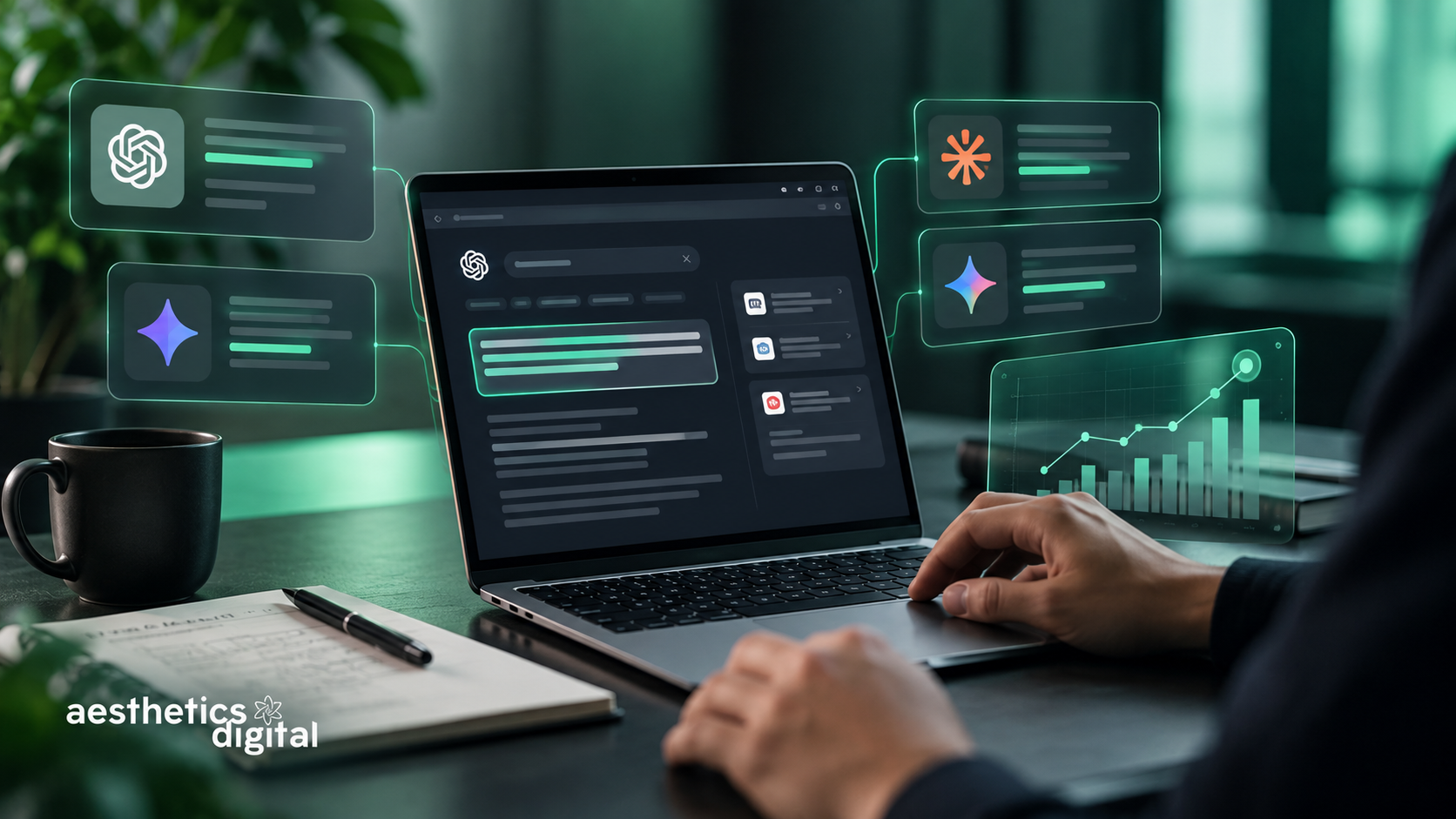
Your brand shows up in ChatGPT. Nice.
Then you notice the awkward part: there is no link.
Do not mark that answer as a loss. And do not count it like a website visit either. An unlinked AI mention is its own visibility event.
You measure it through mention rate, recommendation context, AI share of voice, answer accuracy, prompt coverage, and downstream branded demand, while tracking citations separately.
That distinction matters. In an Ahrefs analysis of more than 31,000 brand mentions, its own site received a link in only 10.7% of AI Overview mentions and 26.9% of ChatGPT mentions, versus 51.6% in Perplexity.
The study is brand-specific, so those percentages are not universal benchmarks. But they prove the larger point: AI visibility can exist without referral traffic.
That is the part most dashboards still make unnecessarily fuzzy.
Key takeaways
- Mentioned and cited are two different states.
- Track visibility against a fixed set of buyer prompts, not random screenshots.
- Measure whether AI names you, recommends you, describes you correctly, and places you beside the right competitors.
- Use branded search, direct demand, leads, and self-reported attribution as supporting business signals.
- Never use one AI visibility score as the whole story.
-
.png)
How do you measure AI search visibility without a link?
Measure the AI answer itself first, then measure what happens around it.
For each fixed buyer prompt, record whether your company appears, how prominently it appears, whether it is recommended, what the answer says about you, which competitors appear, and whether your website or another source receives the citation.
Adobe makes the same useful distinction: visibility means the brand appears; a citation means owned content is used as a supporting source.
Your tracking sheet should therefore treat these as separate fields.
Think of it like a billboard. Someone can remember your name without tapping the billboard.
That is why traditional click-only reporting misses part of the story. Your broader digital marketing strategy should connect search visibility to demand, while your SEO program still handles crawlability, rankings, content relevance, and discoverability.
What is the difference between an AI mention, citation, and recommendation?
A mention tells you that the model knows your brand. A citation tells you that a page or domain helped support the answer.
A recommendation tells you that the model considers your business relevant enough to put into the buyer’s consideration set.
Those three outcomes can happen independently.
For example:
- “Aesthetics Digital is a Delaware marketing agency.” = mention
- An answer links to an Aesthetics Digital article but never names the agency = citation without visible brand mention
- “Consider Aesthetics Digital for…” = recommendation
- The answer names the business and links to it = mention + citation
Semrush recommends evaluating presence, accuracy, competitive position, citation share, sentiment, and prompt-level visibility trends, rather than treating raw traffic as the AI visibility metric.
This is also why your content marketing strategy matters. Content can teach an AI system what you know, while your homepage, service pages, and third-party references help establish who you are.
For more on that distinction, read our GEO vs. SEO guide.
Which AI visibility KPIs should a B2B company actually track?
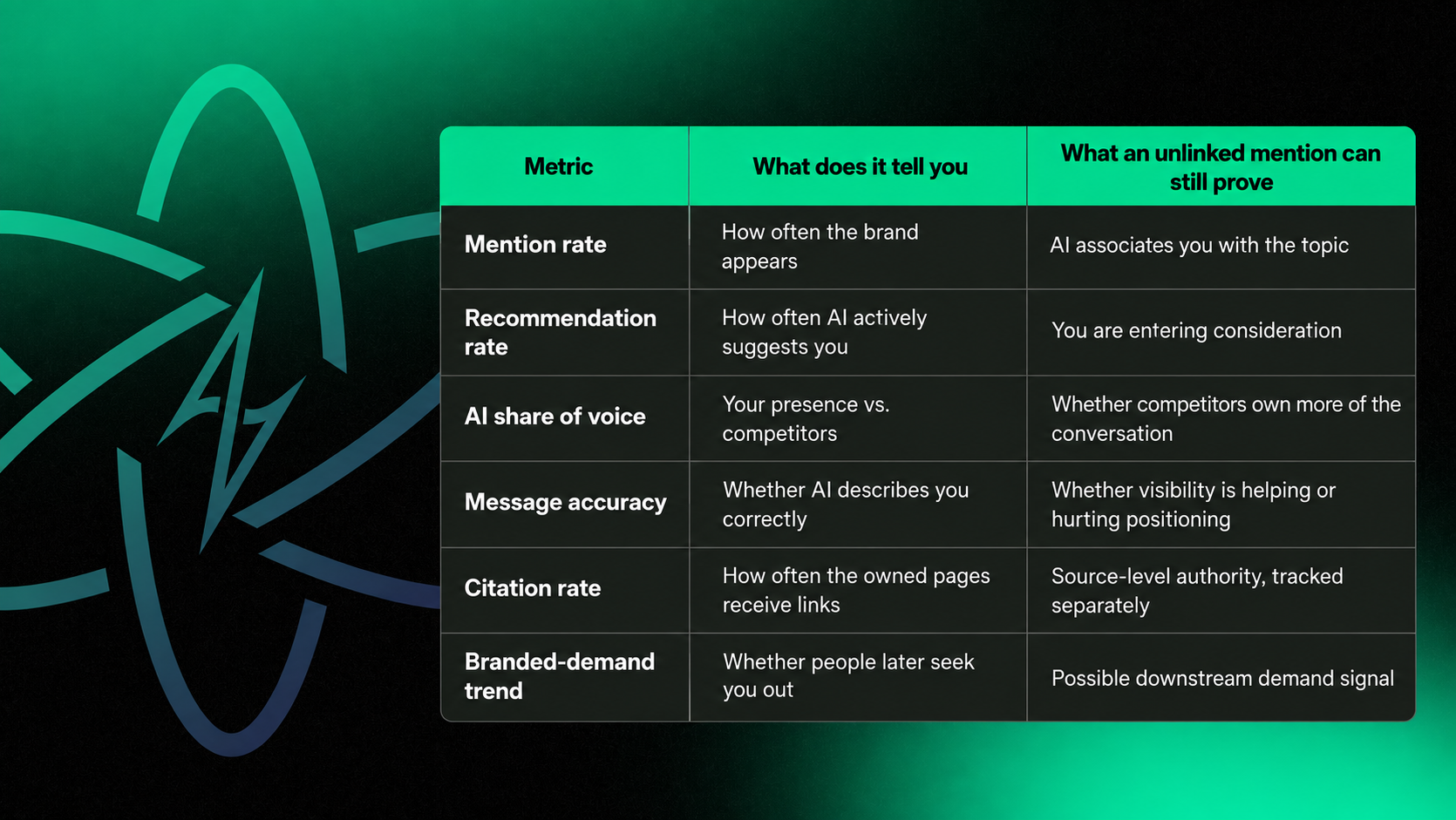
Start with six: mention rate, recommendation rate, AI share of voice, message accuracy, citation rate, and business-response signals.
Then segment them by platform, topic, buyer intent, and reporting period. Otherwise one blended percentage can hide the exact problem you need to fix.
Your baseline should include:
- Mention rate
Answers mentioning you ÷ relevant answers tested. - Recommendation rate
Answers actively recommending you ÷ relevant answers tested. - AI share of voice
Your tracked mentions relative to named competitors. - Message accuracy
Does AI get your service, market, differentiators, and audience right? - Citation rate
How often does the answer link to your domain? - Downstream demand
Watch branded searches, direct visits, conversions, sales-call attribution, and “How did you hear about us?” responses.
Google says AI Overviews and AI Mode traffic is included inside the Web search type in Search Console rather than reported as a clean standalone AI channel. Google therefore recommends combining Search Console with analytics and conversion data.
That makes your website experience part of the measurement problem too. AI can create curiosity. Your site still has to convert it.
For B2B teams, that same trail should continue into nurture. Your email marketing system can capture what happens after a visitor finally identifies themselves.
.png)
How do you know whether an unlinked AI mention is actually valuable?
An unlinked mention becomes valuable when it appears repeatedly for commercially relevant prompts, represents your business accurately, competes well against alternatives, and is followed by stronger branded demand or conversion signals.
One random ChatGPT screenshot proves almost nothing.
Use a fixed prompt set.
Include questions from several stages:
- “What companies help with [problem]?”
- “Best [service] for [industry]”
- “[Competitor] alternatives”
- “Who offers [specific capability]?”
- “Which provider is best for [buyer constraint]?”
Then keep the wording stable.
Semrush specifically warns that expanding your prompt set during a reporting cycle can artificially inflate mentions and make improvement look larger than it is.
This is especially important across markets. A roofing company, healthcare clinic, and solar contractor do not trigger the same buyer questions.
Aesthetics Digital already works across verticals including roofing, healthcare, and solar, so prompt tracking should reflect each customer journey rather than recycling one generic “best agency” list.
The same applies to home improvement and aesthetics businesses. Context is the metric before the metric.
Can you connect AI mentions to leads and revenue?
You can build a credible attribution case, but you usually cannot claim that every unlinked mention caused a specific lead.
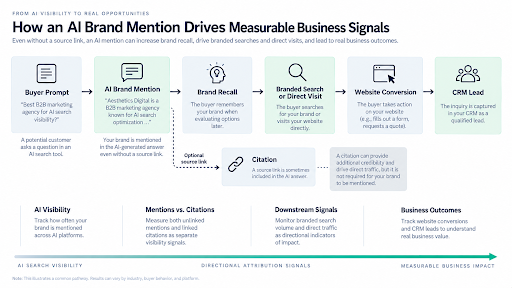
Instead, connect AI visibility trends with branded search, direct traffic, AI referrals, conversion data, self-reported attribution, and sales conversations across several reporting periods.
Semrush recommends pairing AI visibility signals with branded search volume and conversion data, because no single metric cleanly proves AI-search ROI.
So build a chain:
More relevant AI mentions → stronger branded demand → more qualified visits → more conversions
Then test whether the data actually supports it.
Do not reverse-engineer causation because the graph looks pretty.
This matters because buyer research itself is changing. Our guide to how B2B buyer behavior changed in 2026 explains why more of the discovery process can happen before a prospect reaches a salesperson.
You can also compare channel performance against documented case studies instead of treating AI visibility as an isolated marketing trophy.
How can you improve AI visibility once you know what is missing?
Fix the signal that is actually weak. Low mentions, inaccurate mentions, weak recommendations, and poor citation coverage are four different problems.
Publishing five more generic blogs because “AI visibility is down” is the search-marketing version of turning the computer off and hoping accounting improves.
If mentions are low, strengthen entity clarity and category relevance.
If mentions are high but recommendations are weak, improve proof, positioning, comparisons, and buyer-fit language.
If your positioning is wrong, update inconsistent owned pages and influential third-party sources.
If citations are weak, strengthen useful, crawlable, evidence-backed content. Google says ordinary SEO fundamentals still apply to AI features, including crawlability, internal links, textual accessibility, useful content, and structured data that matches visible page content.
That means your AI strategy still needs a technically solid Aesthetics Digital website, not a pile of “LLM hacks.”
And if you sell into multiple niches, your entity signals need to match the actual market. A roofing marketing page should answer roofing-buyer questions.
A healthcare marketing page should not sound like the same template with “doctor” pasted over “roofer.”
The metric that matters most
Do not ask only, “Did AI link to us?”
Ask:
Did the right buyer question cause AI to include us, describe us correctly, put us into consideration, and create measurable demand afterward?
That is AI search visibility worth reporting.
If your team needs a repeatable baseline instead of another screenshot folder, Aesthetics Digital can map your priority prompts, competitors, AI mentions, citations, content gaps, and conversion signals into one measurement framework.
FAQs

At Aesthetics Digital, big ideas deserve bold execution.
Table of Content


%20(1).png)



.svg)

.svg)
.svg)


.svg)