





Three frontier AI models landed within days of each other.
Naturally, the internet responded with enough benchmark tables to wallpaper a conference room.
Here is the part your business actually needs: you probably do not need to rebuild your marketing around a new model. But you may need to rebuild parts of your website and workflow around what these models can now do.
- GPT-6 Astra can browse, operate software, build websites, and complete longer computer-based tasks.
- Claude Fable 5.1 pushes deeper into long-running reasoning, research, and agentic knowledge work.
- Gemini 3.8 Flash combines strong agent workflows with native multimodal input and much cheaper API economics.
The real shift is not “AI got smarter.”
AI is getting better at doing the work after the answer.
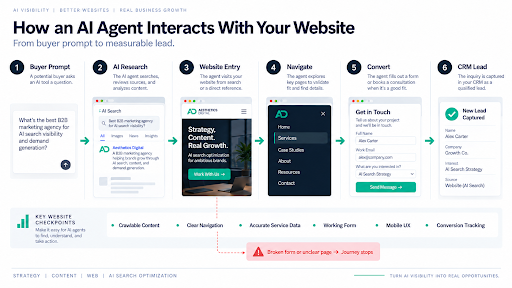
For your website, that means AI systems are moving closer to researching you, comparing you, navigating your pages, understanding video and images, checking your forms, and potentially helping a buyer complete the next step.
That changes more than your prompt library.
Key takeaways
- GPT-6 Astra matters most for computer-use and multistep workflow automation.
- Claude Fable 5.1 matters most where deep reasoning and persistent context are expensive failure points.
- Gemini 3.8 Flash matters when scale, multimodal input, speed, and API cost matter.
- Your website increasingly needs to work for people, search engines, and AI agents.
- Better models will not rescue bad positioning, weak pages, broken forms, or generic content.
.png)
What changed in GPT-6 Astra that actually matters for marketing?
GPT-6 Astra matters because OpenAI pushed the model further from “generate something” toward “complete a workflow.”
It can browse websites, interact with software, create and test web experiences, work across professional applications, and continue through multistep assignments rather than stopping at a draft.
For a marketing team, useful applications include:
- researching competitors across multiple sources
- building campaign assets from one approved brief
- checking landing-page functionality
- working across spreadsheets and documents
- assisting with CRM administration
- performing browser-based QA
- turning research into finished marketing deliverables
OpenAI reports that Astra scored 72.6% on OSWorld 2.0 and completed those simulated computer-use tasks in roughly 40 minutes versus about 75 minutes for GPT-5.6 Sol.
Vendor benchmarks are not your business case, but the direction is clear: computer use is becoming a serious product capability.
That makes your website design and development more important, not less.
If an agent reaches your site and the quote form breaks, your navigation makes no sense, or key information lives inside inaccessible interactions, a smarter model simply discovers the problem faster.
What does Claude Fable 5.1 change for B2B content and research?
Claude Fable 5.1 is more relevant when the marketing task is long, context-heavy, and expensive to get wrong.
Anthropic positions it for demanding reasoning, long-horizon agentic work, research, coding, and document-heavy professional workflows.
Its practical marketing use cases are less flashy but highly useful:
- synthesizing long customer-research datasets
- analyzing large content libraries
- comparing lengthy technical documents
- maintaining context through complex strategy work
- running long research or coding loops
- producing deep first drafts from extensive source material
Fable 5.1 supports a 1 million-token context window and 128K maximum output. Anthropic also reduced cache-read pricing to $0.25 per million tokens, which can matter when an agent repeatedly works from the same large knowledge base.
For your content marketing strategy, that creates a useful distinction.
Do not ask AI to “write more blogs.”
Use it to understand more before it writes one.
That fits the same search principle behind our guide to structuring content for AI engines: original evidence, clear answers, and useful context beat bulk output.
Why might Gemini 3.8 Flash matter more than the headline models for everyday marketing?
Gemini 3.8 Flash matters because many real marketing workloads need speed, multimodal input, and low cost more than maximum benchmark performance.
Google positions it for autonomous agents, software engineering, and complex enterprise workflows, with a 1 million-token context window and 64K maximum output.
Its September 2026 introductory API price is $0.75 per million input tokens and $3.75 per million output tokens, rising to $1.50 and $7.50 respectively from January 1, 2027.
The multimodal piece is especially interesting.
Gemini 3.8 Flash can work natively across text, imagery, audio, and video. That can make it useful for:
- mining recorded customer calls
- reviewing video creative at scale
- analyzing product demonstrations
- categorizing social content
- extracting themes from webinars
- turning mixed media into campaign inputs
Tom’s Guide highlighted video understanding as one of its clearest differentiators versus Astra and Fable 5.1.
For teams producing high-volume content across web, social, search, and email, that can matter more than winning a reasoning benchmark.
.png)
Which AI update matters most for your website and marketing stack?
The answer depends on the bottleneck you are fixing. There is no useful universal winner.
A model that is brilliant at computer use can be wasteful for cheap classification. A fast multimodal model can be the wrong tool for a difficult research synthesis.
%20(1).png)
That last two rows are the ones worth remembering.
A new model does not automatically make you more visible in AI answers.
For that, you still need the fundamentals covered in our GEO vs. SEO guide: crawlable pages, clear entities, useful answers, evidence, and strong topical relationships.
And a smarter agent does not make your form convert.
That is still a digital marketing and CRO problem.
Do these AI updates change how your business website should be built?
Yes, but not because you need an “AI website.” You need a site that AI systems can understand and use without making the human experience worse.
Focus on the boring things first. They are becoming less boring by the week:
- Make navigation obvious.
Pages should have descriptive labels and predictable hierarchy. - Keep important information in crawlable text.
Do not bury pricing logic, services, locations, FAQs, or eligibility inside decorative interactions. - Make conversion actions work cleanly.
Forms, booking tools, calculators, and contact flows need clear states and error handling. - State what your business actually does.
AI systems should not need detective work to understand your services, audience, geography, and proof. - Use original evidence.
Case studies, first-party data, expert commentary, comparisons, and real examples give models something worth retrieving.
Aesthetics Digital already frames its SEO services around search ecosystems rather than algorithm chasing.
That approach becomes more useful as discovery spreads across Google, ChatGPT, Gemini, Perplexity, and other AI interfaces.
The same issue appears across industries. A healthcare site needs clean service and patient information.
A roofing site needs clear project scope and service areas. Solar companies need qualification details an AI system can parse without inventing the missing pieces.
Should you switch your marketing team to the newest AI model?
Not by default. Test the task, not the logo. Switching every workflow whenever a frontier model launches creates migration work without proving a business outcome.
Run a small eval instead.
Take five repeatable jobs:
- competitor research
- landing-page QA
- long-form content analysis
- lead categorization
- campaign repurposing
Give each model the same source material, instructions, and acceptance criteria.
Then measure:
- accuracy
- editing time
- task completion
- failure rate
- API or subscription cost
- human review required
That is a more useful scorecard than asking which model is “smartest.”
It also fits how modern B2B buying works. As our analysis of B2B buyer behavior in 2026 explains, prospects increasingly research vendors before they ever raise a hand.
AI can help you serve that journey, but only if your marketing foundation gives it something good to work with.
Your email marketing, website, content, search presence, and sales follow-up still have to connect.
AI just makes the gaps harder to hide.
What should a B2B company do next?
Audit the workflow before buying another tool. Find the parts of your marketing operation where people spend too much time moving information, checking repetitive work, reviewing large inputs, or switching between systems.
Then test the model against that bottleneck.
You can use Aesthetics Digital’s case studies as the right mental model: judge technology by what changes in the marketing system, not by what looked impressive in a demo.
For an aesthetics practice, that may mean content research and lead follow-up.
For a home improvement company, it may mean quote-flow QA, service-page coverage, and local search research.
Different bottleneck. Different AI job.
Aesthetics Digital can map your website, search visibility, content system, and lead workflows to identify where AI automation creates measurable value and where another shiny subscription would just become another browser tab.
FAQs

At Aesthetics Digital, big ideas deserve bold execution.
Table of Content


%20(1).png)


.svg)

.svg)
.svg)


.svg)