



.jpg)
Let's cut to the chase.
Marketing in 2026 isn't just evolving, it's been completely flipped on its head.
Half of all Google searches now include an AI Overview.
Short-form video drives the highest ROI of any content format. And third-party cookies? Gone. For good.
If you're still running the same strategy you used two years ago, you're not just falling behind, you're invisible.
What Is the Biggest Digital Marketing Trend in 2026?
There's no single winner, but five trends are reshaping how businesses get found, build trust, and drive revenue. Let's break them down.
Trend #1 — AI-Powered Search Is Rewriting the Rules (GEO & AEO)
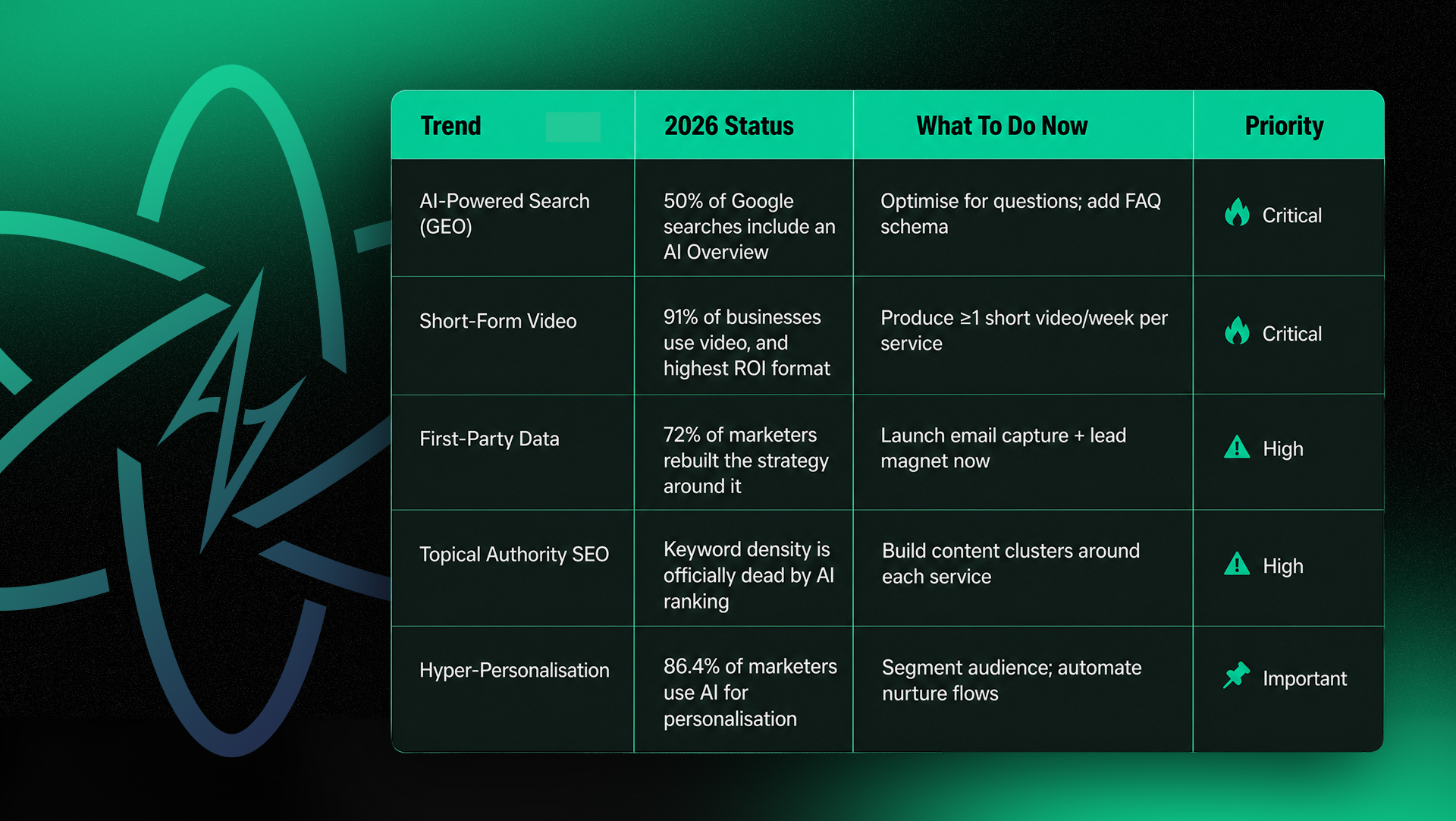
Here's the thing: 50% of all Google searches now include an AI Overview. That means half your potential customers are reading a machine-generated answer before they ever click a link.
Welcome to the era of Generative Engine Optimisation (GEO) and Answer Engine Optimisation (AEO).
The kicker? AI search visitors convert at 4.4x the rate of traditional organic visitors. Lower volume, dramatically higher quality.
What to do:
- Structure every blog post around a specific question your customer is already asking
- Add FAQ schema markup to all service pages
- Write direct, 40–60 word answers under every H2, AI loves it, humans love it
- Get your business cited in authoritative third-party sources (reviews, directories, press.
Our SEO services and content marketing strategies are already built for this, we've seen 49% organic traffic increases in four months using this exact framework.
Trend #2 — Short-Form Video Now Drives Real Revenue
Short-form video isn't just for teenagers dancing on TikTok anymore.
91% of businesses now use video as a core marketing tool, and videos under 60 seconds generate 2.5x more engagement per impression than any other content type.
More importantly: 82% of consumers say a video directly influenced a purchase decision. That's not awareness, that's money on the table.
What to do:
- Post one short video per week for each service you offer, keep it under 60 seconds
- Lead with the result ("Our client went from 0 to page 1 in 90 days") then explain how
- Repurpose every blog post into a 30-second LinkedIn or Instagram reel
Not sure how to tie it into your social media marketing? That's the exact game we play for clients across Delaware every month.
Trend #3 — First-Party Data Is the New Currency
Third-party cookies are dead and buried. Over 72% of global marketers have completely rebuilt their strategies around first-party data, the information customers willingly hand you in exchange for value.
Think email lists. Think quiz results. Think downloadable guides. If you're not actively building a proprietary audience, you're renting one from Google and Meta, and that lease can expire overnight.
What to do:
- Create a lead magnet (checklist, audit, calculator) relevant to your industry
- Add email capture to every blog post — not just the homepage
- Run a simple email nurture sequence that educates first, sells second
Trend #4 — Topical Authority Is Replacing Keyword Stuffing
40.6% of marketers are updating their SEO strategy specifically because AI search rewards expertise-driven content clusters, not isolated keyword-optimised posts.
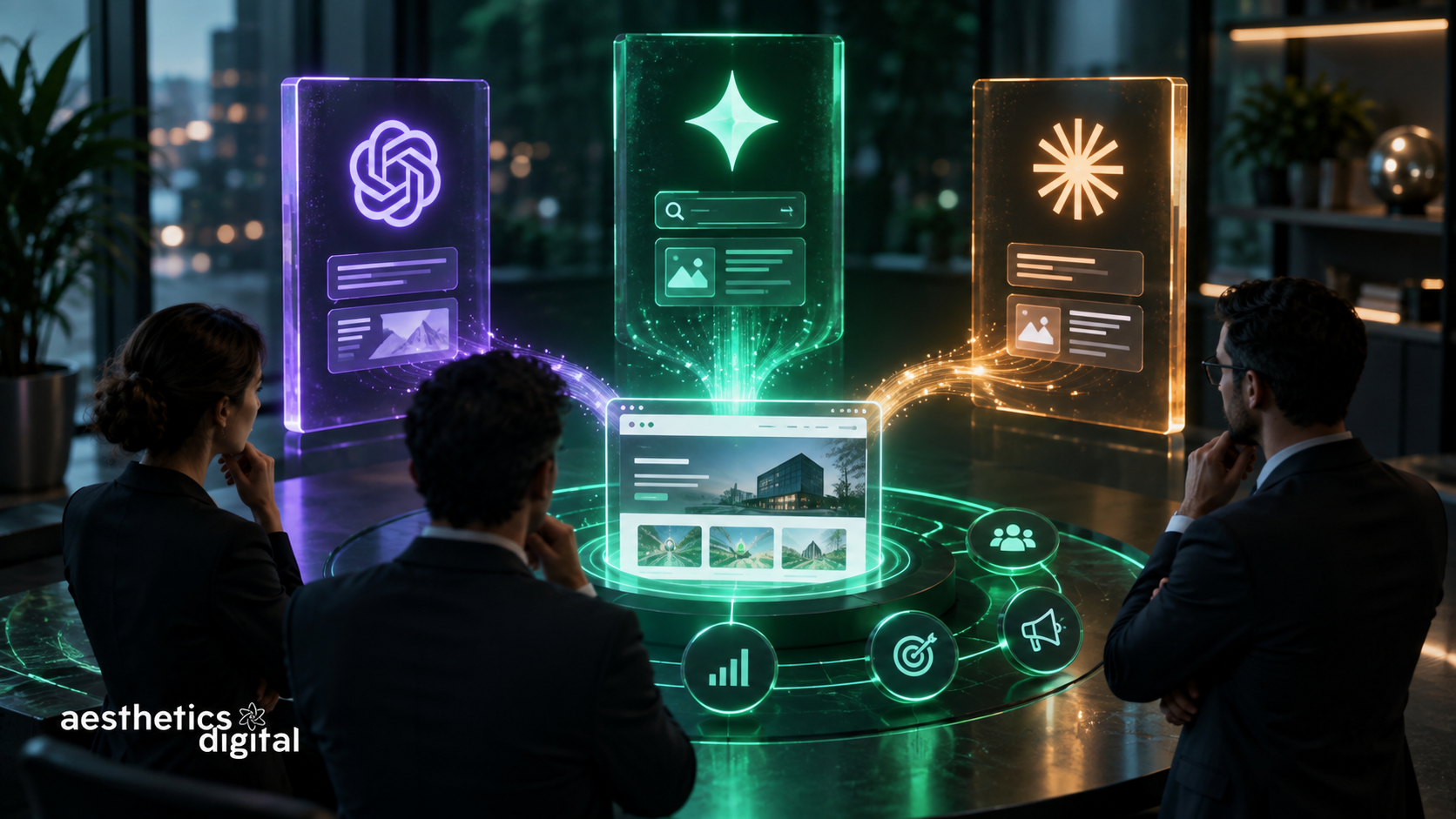
Google's algorithm and AI systems like ChatGPT both ask the same question:
"Is this brand the definitive answer in this topic space?"
One blog post can't answer that. A cluster of 10–15 interconnected articles can.
We covered this in depth in our post on 5 Hard Truths About 2026 Search Market Share and it's one of the most important reads if you care about long-term organic rankings.
What to do:
- Map one pillar page (2,500+ words) to each core service or industry you serve
- Write 3–5 supporting articles that link back to the pillar
- Interlink your service pages, industry pages, and blog posts, make Google crawl a web, not a dead end
Trend #5 — Hyper-Personalisation at Scale
86.4% of marketers now use AI tools to create personalised content.
Generic messaging isn't just ineffective, it's actively repelling modern buyers who expect brands to speak directly to their situation.
A roofing company and a med-spa have completely different pain points. If your agency talks to both with the same blog post, both feel like you're talking to neither.
Also worth reading: our breakdown of The Dead Internet Theory and why generic content is losing.
What to do:
- Segment your email list by industry or business type before sending
- Create landing pages that speak directly to one ICP — not 'all businesses'
- Use behavioural triggers (page visits, downloads) to automate personalised follow-ups
Is SEO Still Worth It in 2026?
Short answer: absolutely.
Websites, blogs, and SEO remain the most popular and highest-impact channels for B2B companies in 2026. What's changed is how you do it, not whether you should.
Our team has a proven SEO framework built for exactly this environment and we'd love to show you what it looks like applied to your industry.
2026 Digital Marketing Trends, Quick Snapshot
How Can Small Businesses Use These Trends?
Here's the good news: you don't have to do all five at once. That's a recipe for burning out and doing nothing well.
Start with these three moves:
- 1. Fix your blog → Add dates, CTAs, and internal links to every existing post (one afternoon of work)
- 2. Record one video this week → Film a 60-second answer to a question your best client asked you last month
- 3. Launch one lead magnet → A simple PDF checklist relevant to your industry is enough
Not sure where to start? We put together 10 AI marketing tools that'll save you 6 hours of work per week, a great starting point.
Ready to Adapt? Here's Your Next Move
If reading this felt like drinking from a firehose, that's okay, you don't have to figure this out alone.
At Aesthetics Digital, we help Delaware businesses build content strategies, SEO systems, and paid media frameworks that are already built for 2026, not playing catch-up with it.
From content marketing to PPC management to full-funnel SEO, we've got the systems, and more importantly, we've got the results to back them up.
Frequently Asked Questions

At Aesthetics Digital, big ideas deserve bold execution.
Table of Content


%20(1).png)


.svg)

.svg)
.svg)


.svg)