
Universal TOC for Webflow – CMS & Static Content Ready

View CMS page demo
Published on
22 Jan 2024
Desk with computer
TABLE OF CONTENT
Subscribe to our newsletter
Read about our privacy policy.
Thank you! Your submission has been received!
Oops! Something went wrong while submitting the form.

For the ToC we use H1-H4

Mi tincidunt elit, id quisque ligula ac diam, amet. Vel etiam suspendisse morbi eleifend faucibus eget vestibulum felis. Dictum quis montes, sit sit. Tellus aliquam enim urna, etiam. Mauris posuere vulputate arcu amet, vitae nisi, tellus tincidunt. At feugiat sapien varius id.

Eget quis mi enim, leo lacinia pharetra, semper. Eget in volutpat mollis at volutpat lectus velit, sed auctor. Porttitor fames arcu quis fusce augue enim. Quis at habitant diam at. Suscipit tristique risus, at donec. In turpis vel et quam imperdiet. Ipsum molestie aliquet sodales id est ac volutpat.

Meeting
Image caption goes here

‍

Elit nisi in eleifend sed nisi. Pulvinar at orci, proin imperdiet commodo consectetur convallis risus. Sed condimentum enim dignissim adipiscing faucibus consequat, urna. Viverra purus et erat auctor aliquam. Risus, volutpat vulputate posuere purus sit congue convallis aliquet. Arcu id augue ut feugiat donec porttitor neque. Mauris, neque ultricies eu vestibulum, bibendum quam lorem id. Dolor lacus, eget nunc lectus in tellus, pharetra, porttitor.

"Ipsum sit mattis nulla quam nulla. Gravida id gravida ac enim mauris id. Non pellentesque congue eget consectetur turpis. Sapien, dictum molestie sem tempor. Diam elit, orci, tincidunt aenean tempus."

Tristique odio senectus nam posuere ornare leo metus, ultricies. Blandit duis ultricies vulputate morbi feugiat cras placerat elit. Aliquam tellus lorem sed ac. Montes, sed mattis pellentesque suscipit accumsan. Cursus viverra aenean magna risus elementum faucibus molestie pellentesque. Arcu ultricies sed mauris vestibulum.

How to know what design works better

Senectus nam posuere ornare leo metus, ultricies. Blandit duis ultricies vulputate morbi feugiat cras placerat elit. Aliquam tellus lorem sed ac. Montes, sed mattis pellentesque suscipit accumsan. Cursus viverra aenean magna risus elementum faucibus molestie pellentesque. Arcu ultricies sed mauris vestibulum.

Montes, sed mattis pellentesque suscipit accumsan. Cursus viverra aenean magna risus elementum faucibus molestie pellentesque. Arcu ultricies sed mauris vestibulum. Montes, sed mattis pellentesque suscipit accumsan. Cursus viverra aenean magna risus elementum faucibus molestie pellentesque. Arcu ultricies sed mauris vestibulum.

Nunc sed faucibus bibendum feugiat sed interdum. Ipsum egestas condimentum mi massa. In tincidunt pharetra consectetur sed duis facilisis metus. Etiam egestas in nec sed et. Quis lobortis at sit dictum eget nibh tortor commodo cursus.

‍

How to manage A/B testing on Webflow

Morbi sed imperdiet in ipsum, adipiscing elit dui lectus. Tellus id scelerisque est ultricies ultricies. Duis est sit sed leo nisl, blandit elit sagittis. Quisque tristique consequat quam sed. Nisl at scelerisque amet nulla purus habitasse.

Nunc sed faucibus bibendum feugiat sed interdum. Ipsum egestas condimentum mi massa. In tincidunt pharetra consectetur sed duis facilisis metus. Etiam egestas in nec sed et. Quis lobortis at sit dictum eget nibh tortor commodo cursus.

Iterate and optimize

Morbi sed imperdiet in ipsum, adipiscing elit dui lectus. Tellus id scelerisque est ultricies ultricies. Duis est sit sed leo nisl, blandit elit sagittis. Quisque tristique consequat quam sed. Nisl at scelerisque amet nulla purus habitasse.

Nunc sed faucibus bibendum feugiat sed interdum. Ipsum egestas condimentum mi massa. In tincidunt pharetra consectetur sed duis facilisis metus. Etiam egestas in nec sed et. Quis lobortis at sit dictum eget nibh tortor commodo cursus.

Conclusion

Morbi sed imperdiet in ipsum, adipiscing elit dui lectus. Tellus id scelerisque est ultricies ultricies. Duis est sit sed leo nisl, blandit elit sagittis. Quisque tristique consequat quam sed. Nisl at scelerisque amet nulla purus habitasse.

Nunc sed faucibus bibendum feugiat sed interdum. Ipsum egestas condimentum mi massa. In tincidunt pharetra consectetur sed duis facilisis metus. Etiam egestas in nec sed et. Quis lobortis at sit dictum eget nibh tortor commodo cursus.

Odio felis sagittis, morbi feugiat tortor vitae feugiat fusce aliquet. Nam elementum urna nisi aliquet erat dolor enim. Ornare id morbi eget ipsum. Aliquam senectus neque ut id eget consectetur dictum. Donec posuere pharetra odio consequat scelerisque et, nunc tortor.

‍
H4 Nulla adipiscing erat a erat.

Etiam egestas in nec sed et. Quis lobortis at sit dictum eget nibh tortor commodo cursus.

H5 Demo, not in use for creating ToC.

sed interdum. Ipsum egestas condimentum mi massa. In tincidunt pharetra consectetur sed duis facilisis metus. Etiam egestas in nec sed et. Quis lobortis at sit dictum eget nibh tortor commodo cursus.

Latest posts

Demo content

Interviews, tips, guides, industry best practices, and news.
Office setting
Design
8 min read

UX review presentations

How do you create compelling presentations that wow your colleagues and impress your managers?
Read post
Man working at desk
Product
8 min read

Migrating to Linear 101

Linear helps streamline software projects, sprints, tasks, and bug tracking. Here’s how to get started.
Read post
Man pinning images on wall

Building your API Stack

The rise of RESTful APIs has been met by a rise in tools for creating, testing, and managing them.
Read post

SEO or Google Ads First? A Delaware Small Business Decision Guide

SEO or Google Ads First? A Delaware Small Business Decision Guide

Category:

Author:

Aesthetics Digital

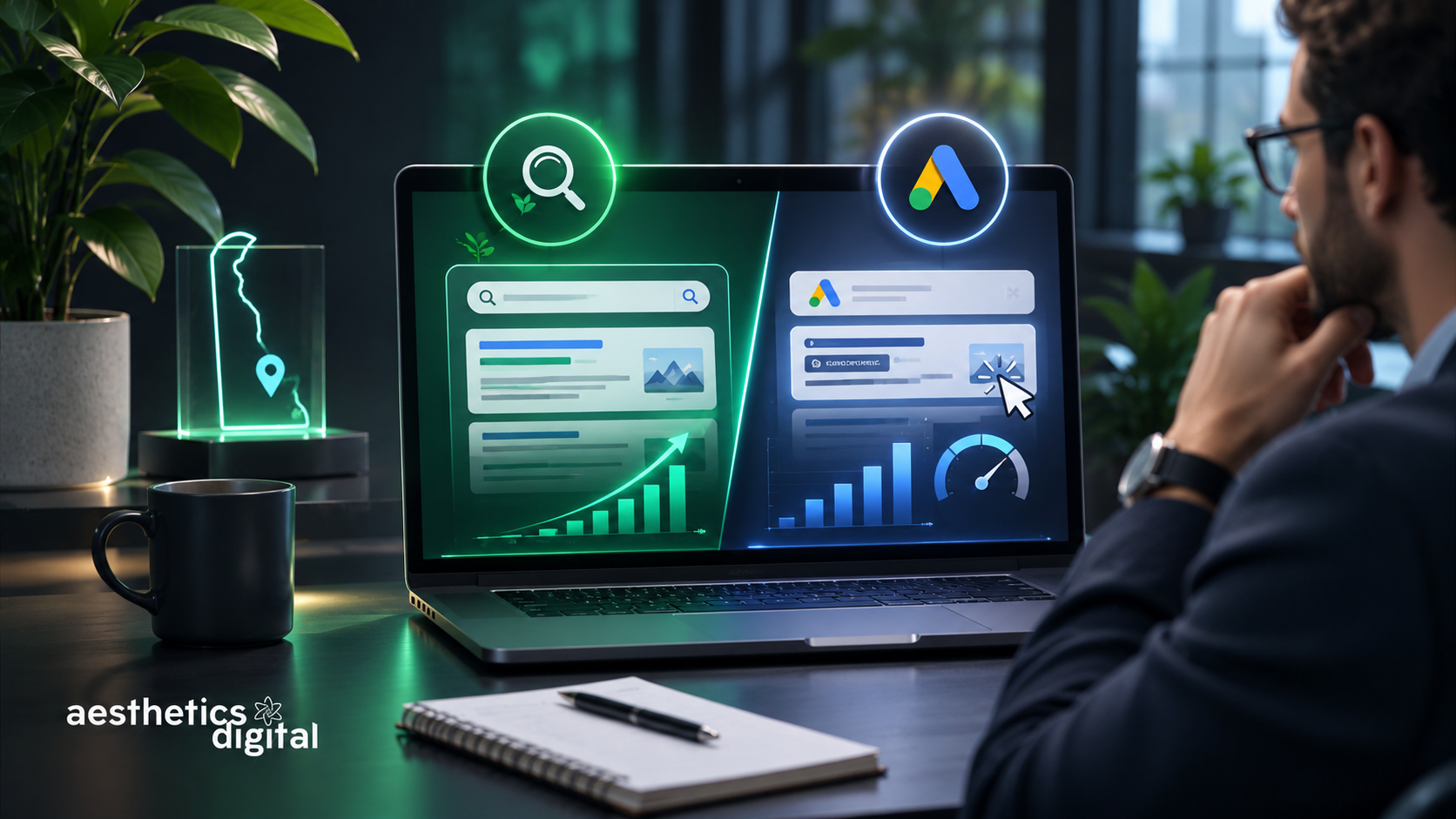
SEO and Google Ads comparison dashboard for a Delaware small business marketing strategy.

SEO or Google Ads First? A Delaware Small Business Decision Guide

Category:

Author:

Aesthetics Digital

SEO and Google Ads comparison dashboard for a Delaware small business marketing strategy.

Should you choose SEO or Google Ads first? Most Delaware small businesses should start with the channel that matches their next business constraint. Google Ads is usually the faster test when you need demand now, can track qualified leads, and have a page that converts.

SEO is usually the stronger first investment when buyers research repeatedly, your site lacks useful service pages, and you can wait for visibility to develop.

The practical answer may be a sequence: fix the landing page and tracking, run a controlled search campaign to learn which offers and queries produce qualified leads, then build SEO around the patterns worth owning.

SEO or Google Ads First: What Is the Difference?

SEO improves how easily search engines can crawl, understand, and surface your pages in unpaid results. Google's SEO Starter Guide emphasizes useful, well-organized content and warns that no change guarantees a top ranking.

Google Ads buys eligible placements for selected searches and audiences. Google explains that ads and organic results are separate, and paying for ads does not improve organic rankings. Ads can create visibility quickly, but traffic depends on active budget, targeting, bids, relevance, and campaign settings.

The decision is not “free traffic versus paid traffic.” Both require investment, measurement, and a page that earns the next step.

When Should Google Ads Come First?

Choose Ads first when the offer is clear, the search intent is commercial, and a lead this month matters more than building a content asset over time. A focused campaign can test service language, geography, calls, forms, and landing-page performance without waiting for organic visibility to develop.

Ads are also useful when seasonality creates a short window. A Delaware contractor with limited spring installation slots may value fast demand testing more than a broad six-month content program.

Do not launch into a broken funnel. If calls are unanswered, forms are unreliable, or the landing page hides the offer, more clicks may only buy more confusion.

Google Ads should come first only when the business can define a qualified conversion and respond to it.

When Should SEO Come First?

Choose SEO first when the market asks recurring questions, your service pages are thin or missing, and long-term discoverability matters. Local businesses often need technically sound pages for each core service, credible location context, useful explanations, and internal links that help both people and search systems understand the site.

SEO is also the better starting point when advertising economics are not yet workable. If the expected value of a lead cannot support competitive acquisition costs, improving the offer, page, local presence, and organic coverage may be the more sensible foundation.

SEO takes time. Google notes that some changes can take weeks or months to show an effect, and not every improvement creates a noticeable result.

Start SEO first when the missing asset is a useful, trustworthy website, not simply more traffic.
‍

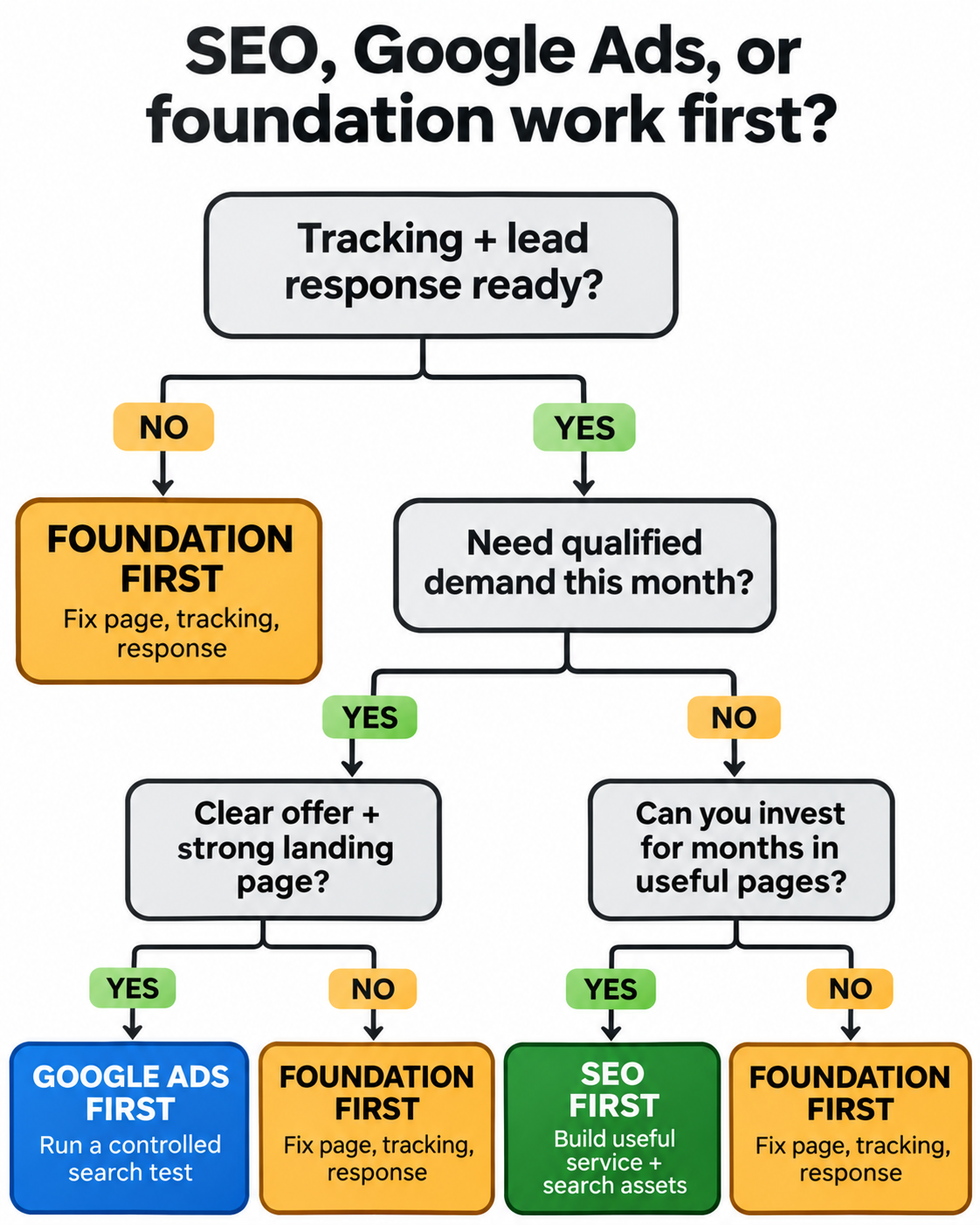
A decision flow directs unready lead processes to foundation work, urgent ready businesses to an Ads test, and longer-term needs to SEO.

Text equivalent: If tracking or lead response is not ready, fix the foundation first. If demand is urgent and the offer and landing page are ready, test Google Ads first. If demand is not urgent and the business can invest for months in useful pages, start SEO; otherwise fix the foundation.

How Should a Delaware Business Compare the Options?
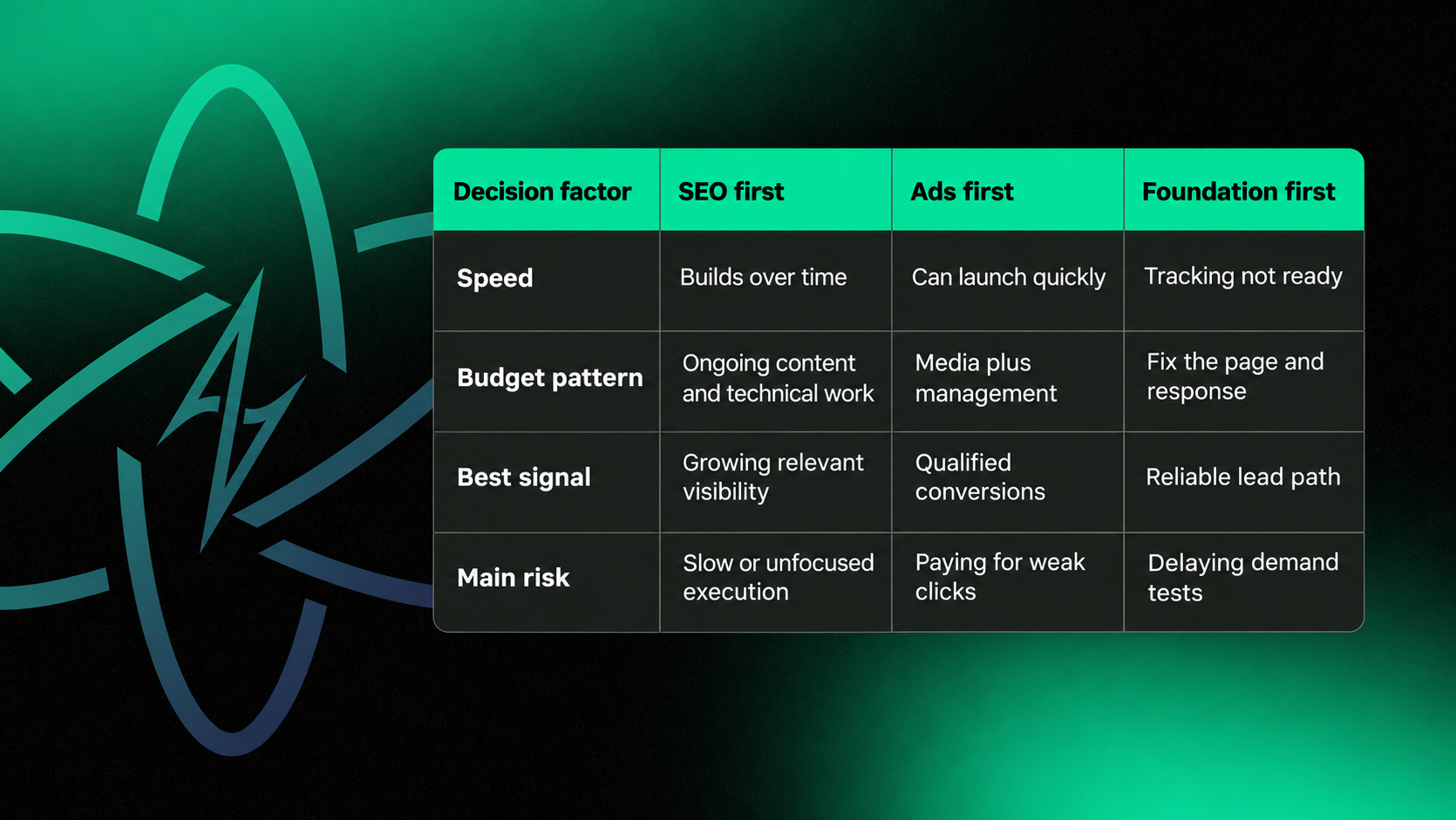
How Should a Delaware Business Compare the Options?

‍

Geography changes the math. A company serving Dover, Wilmington, Sussex County, or the full state should separate service areas that it can actually support. Ads can target locations and schedules directly. Organic pages need genuine local relevance, not a stack of near-duplicate city pages.

Also consider search volume and lead value. A niche B2B service may have fewer searches but higher-value inquiries. A common consumer service may generate more clicks but require faster response and tighter screening.

The best channel is the one that can be measured against qualified inquiries, not the one with the largest traffic number.

What Must Be Fixed Before Either Channel?

Lead-path checklist: Define a qualified inquiry; test the form and phone number on mobile; confirm tracking records the action; assign someone to respond; and check that the offer and service area are clear. Fix any failed step before increasing traffic.

First, define the conversion. Decide whether success means a booked consultation, a phone call longer than a threshold, a completed quote form, or another verified action. Then test the path on mobile.

Second, connect measurement. Use Google Ads conversion tracking for campaigns and Search Console for organic performance. Where appropriate, connect paid and organic reporting so teams can compare search coverage without pretending one channel caused the other to rank.

Third, strengthen the landing page. State who the service is for, where it is offered, what happens next, and what evidence supports the business. Remove distracting calls to action and make contact options work.

Tracking cannot rescue a weak offer, but it can stop a weak offer from hiding behind vanity metrics.

Can SEO and Google Ads Work Together?

Yes, when each channel has a distinct job. Ads can test commercial language and capture urgent demand. SEO can build durable service, comparison, and educational pages. Paid-search query data can inspire questions to research, but it should not be copied blindly into content.

A combined plan also reduces false conclusions. A campaign may show which searches lead to calls, while Search Console shows how unpaid pages gain impressions and clicks. Google's paid and organic report is designed to help advertisers examine both types of visibility together.

Use one measurement framework and separate channel costs. That keeps “working together” from becoming “we cannot tell what worked.”

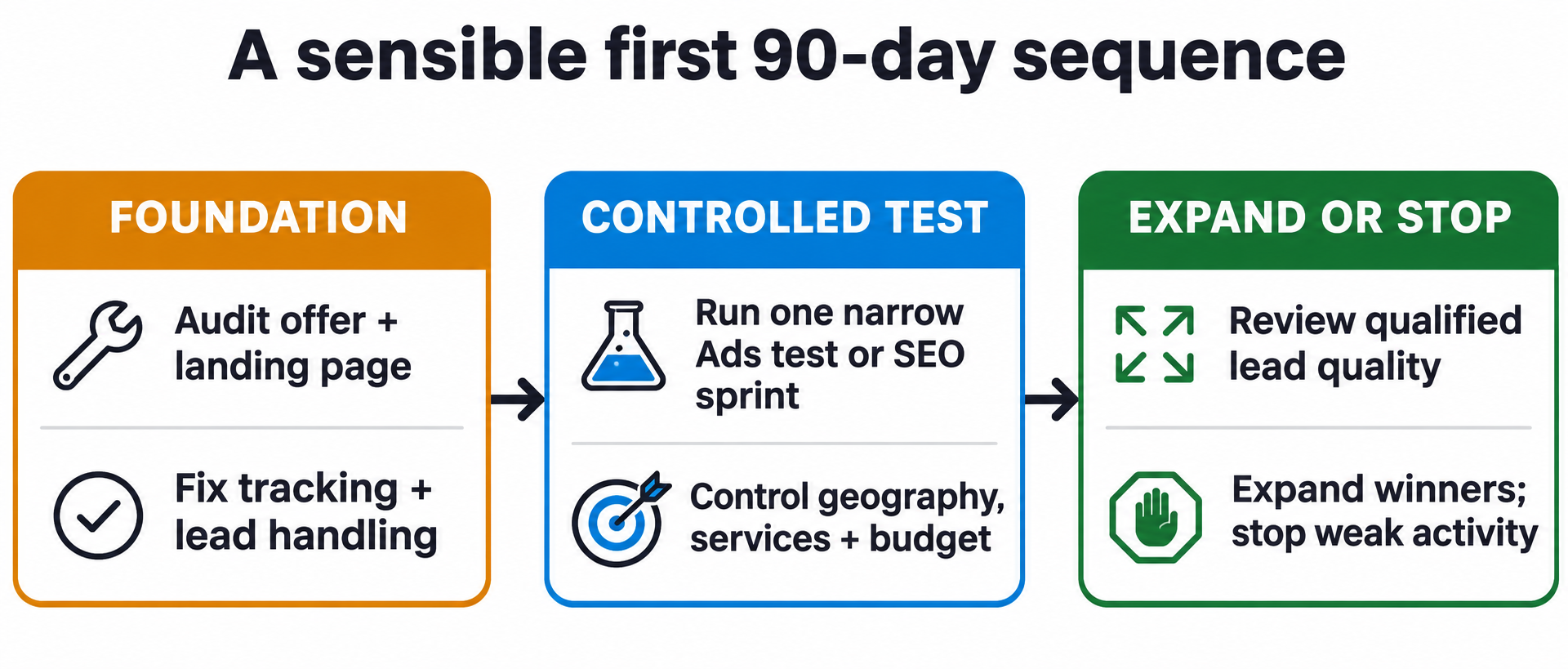
What Is a Sensible First 90-Day Sequence?

In weeks one and two, audit the offer, landing page, lead handling, and conversion tracking. Fix obvious technical and messaging problems before scaling traffic.

Next, launch one narrow test or one focused SEO sprint, depending on the decision rule above. Keep geography, services, and budget controlled. Review lead quality, not just click-through rate.

Finally, decide what to expand. Winning ad themes can inform new landing pages. Strong organic impressions can reveal pages that need better alignment or conversion design. Stop activities that produce activity without useful inquiries.

The goal of the first 90 days is a clearer decision system, not a victory speech.
‍

A three-stage plan moves from fixing the foundation to testing one channel and reviewing lead quality.

Text equivalent: The 90-day sequence has three phases: fix the offer, landing page, tracking, and lead handling; run one controlled Ads test or SEO sprint; then review qualified lead quality and expand winners or stop weak activity.

Frequently Asked Questions (inferred reader questions)

01 Is SEO cheaper than Google Ads?
▾
Not automatically. SEO usually requires strategy, technical work, content, and ongoing improvement. Ads require media spend plus management and landing-page work. Compare total cost against qualified outcomes.
02 How quickly can Google Ads generate leads?
▾
Ads can begin serving after setup and approval, but lead timing and quality depend on demand, targeting, competition, budget, page quality, and response. Immediate visibility is not a lead guarantee.
03 How long does SEO take?
▾
There is no universal timeline. Google says changes may take from hours to several months, and some changes may not produce a noticeable effect. Competitive conditions and site quality matter.
04 Should a new business use both channels?
▾
Possibly, but only if the budget can support proper setup and measurement. A small business may learn more from one controlled channel than from two underfunded programs.
05 Does buying Google Ads help organic rankings?
▾
No. Google states that paid advertising does not affect organic ranking. The channels can share insights, but their placement systems remain separate.

The Decision Rule

Choose Google Ads first for controlled, trackable speed. Choose SEO first when the website and long-term search footprint are the missing assets. Use both when the business can fund, measure, and operate them without blurring their roles.

If the choice still feels fuzzy, review Aesthetics Digital's SEO services and PPC management pages, then discuss the actual constraint through the contact page. A channel plan should start with the business problem, not a package name.

‍

Written by

Aesthetics Digital

At Aesthetics Digital, big ideas deserve bold execution.  

Table of Content
Get insghts that drive results.

Contact us for  strategy, design tips, and industry insights—straight to your inbox.