


An AI assistant may be able to find your business. It may also be able to help a customer reach a reservation, appointment, order, or inquiry. Those are different capabilities, and neither should be assumed.
Discovery depends on whether the assistant can access and interpret accurate business information. Booking depends on the platform, the business category, provider availability, and whether the customer can complete the action safely.
That difference is the useful part of assistant action optimization (AAO). Instead of chasing a new acronym, examine the complete path from answer to action.
What does AAO mean for a small business?
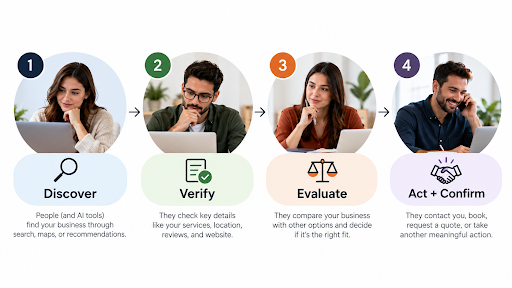
AAO is an emerging label, not a universal technical standard. In this guide, AAO means assistant action optimization. It focuses on making a business easier for an AI-assisted customer journey to discover, verify, evaluate, and use.
It sits beside familiar disciplines:
- SEO: Can search systems crawl, index, and surface the page?
- AEO and GEO: Can answer systems understand the content and cite or summarize it accurately?
- AAO: Can the user move from that answer to the correct business action with minimal confusion?
AAO does not replace SEO services, strong content, or a usable website. It tests whether those foundations connect to a functioning next step.
Google says its AI search features do not require special optimization beyond established SEO fundamentals. There is no special AI schema that guarantees inclusion. Clear content, crawl access, accurate business information, and a usable experience still matter.
Can ChatGPT or another assistant book every business?
No. Booking support varies by assistant, plan, location, business category, provider, and task.
OpenAI documents restaurant reservations in ChatGPT Search for eligible consumer plans. Depending on the restaurant and location, availability may come from OpenTable, Resy, or Yelp. The customer may finish in ChatGPT or with the provider. A reservation is confirmed only after the booking flow is complete and the provider issues confirmation.
That supports a specific restaurant workflow. It does not prove that ChatGPT can book every salon, clinic, contractor, consultant, or local service. Likewise, Google Business Profile action links can help eligible businesses expose appointment, reservation, ordering, or shopping paths. A link still does not mean every assistant can complete the transaction.
The practical question is not "Can AI book businesses?" It is "Can the platforms my customers use find accurate information about this business and reach a working action path for this specific task?"
The four stages of an assistant-ready customer journey
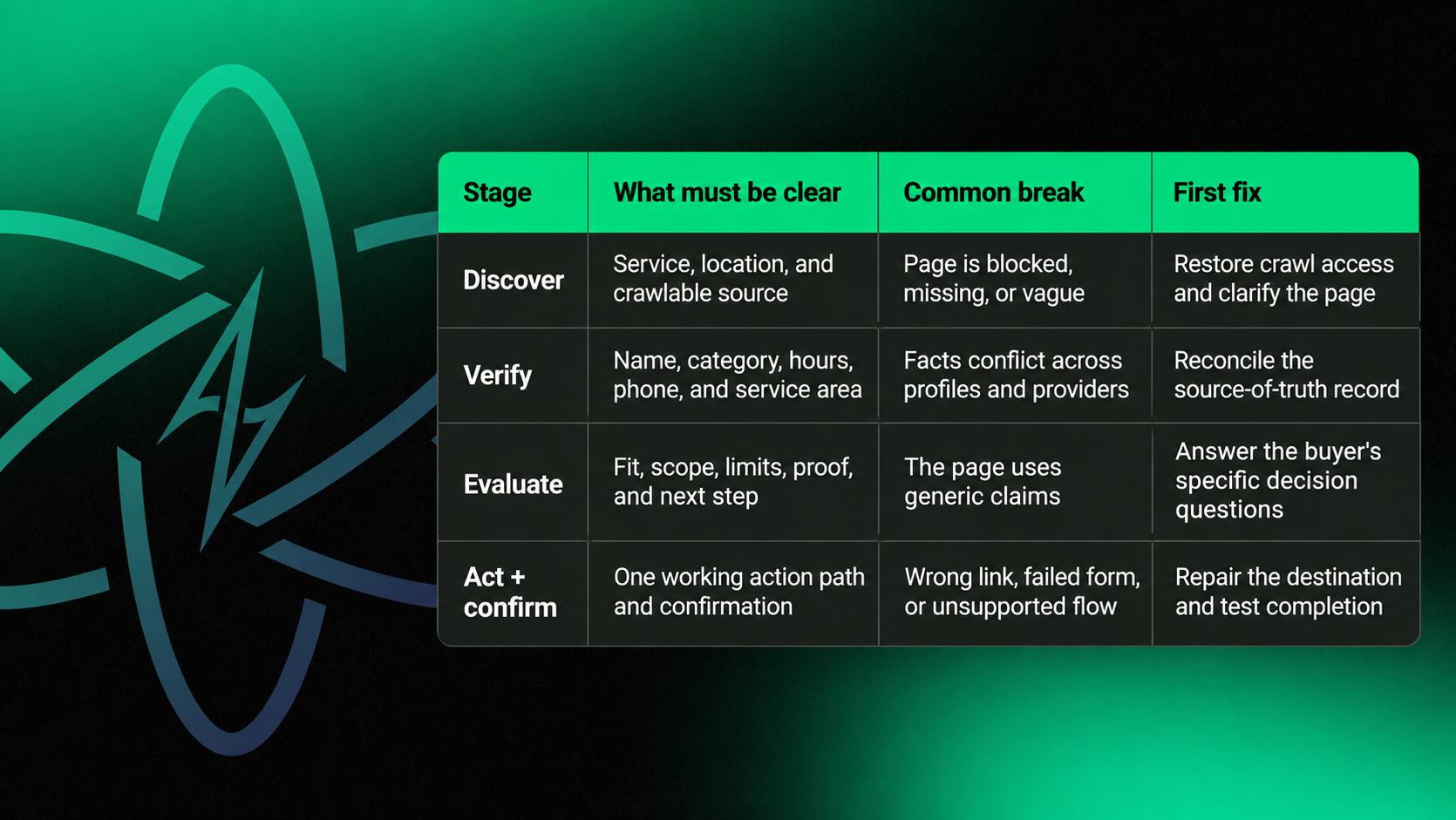
Think of the journey as four gates. If one gate fails, adding complexity later in the path will not solve the underlying problem.
1. Discover
The assistant needs a crawlable, indexable source that explains what the business does. Useful sources can include service pages, location pages, business profiles, reputable directories, and supported booking providers.
For ChatGPT Search, allowing OAI-SearchBot creates eligibility for search-result inclusion; it does not guarantee placement. The site host and content delivery network also need to allow the published crawler traffic.
2. Verify
The assistant and the customer need consistent facts. Keep the business name, category, address or service area, hours, phone number, service limitations, and canonical website aligned. Conflicting facts force both people and systems to decide which version is current.
3. Evaluate
The customer needs enough detail to judge fit. A page that says "custom solutions" but never names the service, intended customer, location, exclusions, or next step is difficult to evaluate.
Clear service pages should answer:
- Who is the service for?
- What problem does it address?
- Where and how is it delivered?
- What is included or excluded?
- What constraints affect timing, eligibility, or compatibility?
- What should the customer do next?
The Aesthetics Digital guide to structuring content for AI search engines explains how direct answers, evidence, and context make individual sections easier to interpret.
4. Act and confirm
The user needs a functioning action link or provider flow. The destination should make the action clear, request only necessary information, explain important terms, and confirm success.
A visible button is not enough. If it opens the wrong location, requires an unsupported login, hides errors, or never confirms submission, the journey is broken.
What information helps an assistant find the correct business?
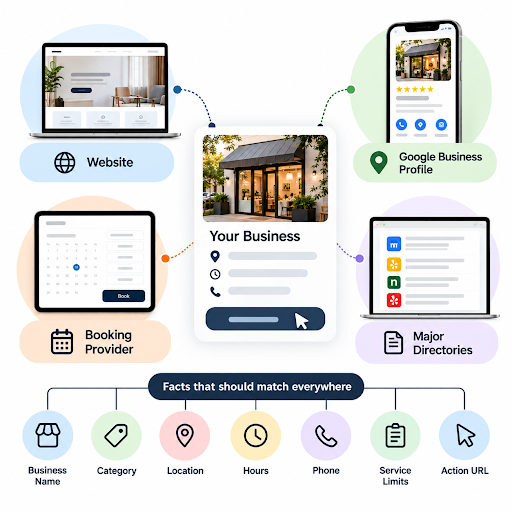
Start with business identity. Create one source-of-truth record containing:
- Exact public business name
- Primary category and specific services
- Address or defined service area
- Customer-facing phone number
- Regular and special hours
- Canonical website and priority service URLs
- Preferred booking, order, or inquiry URL
- Eligibility, location, or service limitations
Compare that record with the website, Google Business Profile, booking provider, and major directories. Fix mismatches that could change a real decision.
A wrong holiday hour can waste a visit. A stale phone number can end an inquiry. Two competing booking links can send customers into different calendars.
How should service pages support assistant-assisted decisions?
Write for a busy customer who needs a concrete answer. Give each priority service a dedicated page when the intent and details are meaningfully different.
A useful page usually includes:
- A direct service definition near the top
- The intended customer or use case
- Delivery method and geography
- Important inclusions, exclusions, and constraints
- Evidence appropriate to the claim
- A descriptive next step
Avoid forcing the customer or assistant to infer that a general capability applies to a specific need. Clear service pages also strengthen content marketing. Related articles can then answer narrower questions without repeating volatile booking details across the site.
What role does structured data play?
LocalBusiness structured data can help Google interpret details such as business type, hours, address, telephone, and location. Use the most specific truthful type that matches the visible page. Keep the markup consistent with what customers can see, and validate it before deployment.
Do not treat structured data as a booking integration. Google provides the Maps Booking API for supported booking partners and actions. Markup can clarify meaning, but it does not create availability, provider eligibility, or guaranteed placement.
How should booking and inquiry links be configured?
Google Business Profile can support action links for eligible businesses. If several links exist for one category, the business can identify a preferred link.
The destination should be specific to the business and action. Google's current business-link guidance says the page should allow the customer to complete the designated action. Broken pages, login walls, CAPTCHAs, geoblocking, and inaccessible resources can prevent verification.
For the website itself, apply the same standard:
- Use descriptive labels such as "Book a consultation" or "Request an estimate."
- Link to the correct location and service.
- Explain duration, time zone, availability, deposits, or preparation when relevant.
- Label required fields and errors.
- Do not request sensitive information before it is needed.
- Provide a human alternative for unusual requests.
- Show a clear confirmation after submission.
These are conversion and usability issues as much as AI issues. A practical web design and development process should test them for customers first.
A seven-step AAO audit for a small business
1. Check crawlability and indexability
Confirm that priority service and location pages return successful responses, use intended canonical URLs, and are not accidentally blocked or marked noindex. Review crawler rules for the systems relevant to the business.
2. Reconcile the business identity
Compare the source-of-truth record with the website, profiles, directories, and providers. Correct the highest-impact mismatch first.
3. Review service clarity
Ask whether each priority page explains the audience, need, location, delivery method, limits, and next step without relying on vague claims.
4. Validate structured data
Check that markup matches visible content and uses appropriate types and properties. Validation is a technical quality check, not a visibility guarantee.
5. Simplify the action path
Choose one preferred path for each important action. Remove avoidable redirects, duplicate calendars, ambiguous buttons, and forms that fail silently.
6. Connect claims to proof
Link service claims to verifiable evidence, relevant policies, case studies, or authoritative third-party sources when appropriate. Keep names and facts consistent across those surfaces.
7. Test the journey as a customer
Use realistic tasks rather than broad prompts. For example:
- Find a web design agency serving a small business in Dover, Delaware.
- Which page explains whether ecommerce work is included?
- Find the correct consultation or inquiry path.
- What information will I need before submitting the form?
- Can I confirm that the request was received?
Record the date, platform, plan or mode, location context, prompt, sources shown, path taken, and result. Treat one successful test as one observation, not a universal score. Interfaces, partner availability, and platform features can change.
What should you fix first?
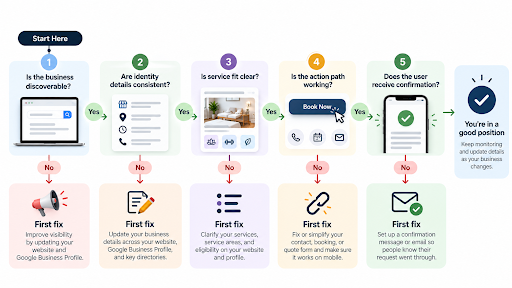
Fix the first failed gate.
- Not discovered: Resolve crawlability, indexing, canonical, and profile problems.
- Wrong identity: Correct business names, categories, locations, hours, and contact details.
- Poor fit explanation: Rewrite priority pages around real services and constraints.
- Weak verification: Add accurate proof, policies, and consistent external references.
- Broken action path: Repair links, forms, provider settings, and confirmations.
- Unsupported transaction: State the handoff honestly. A working provider link is better than claiming native booking that does not exist.
This order keeps the work practical. Adding an integration cannot fix a business an assistant cannot identify correctly.
Frequently asked questions
Build a reliable path from answer to action
AI-assisted booking is not one universal feature. It is a chain of dependencies.
Make the business discoverable. Keep its identity consistent. Explain services and limits in plain language. Use accurate structured data where appropriate. Maintain one clear action path, and test whether a customer can complete it.
That work improves the experience even when an AI assistant is not involved.
Need help connecting search visibility, content, and a usable conversion path? Talk with Aesthetics Digital about your digital strategy.

At Aesthetics Digital, big ideas deserve bold execution.
Table of Content